
Technology
Gateways and Whole-Home Backup
A battery on its own does not keep your lights on in a power cut. The part that does is the gateway. This page explains what a gateway is, what it can and cannot carry, and what it adds to a job.
- Energy gateways
- Whole-home and essential-circuit backup
- Changeover and islanding
- G98 / G99
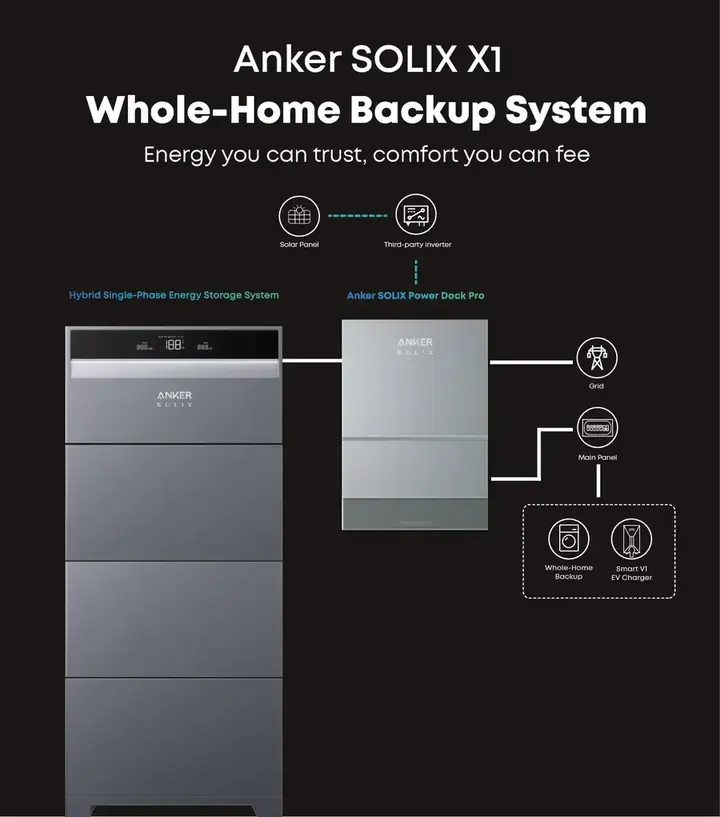
What a gateway actually is
A gateway is a switching and metering unit that sits between your consumer unit and the incoming supply. In normal running it measures what the house is importing and exporting, and tells the inverter what to do with the electricity the array is producing. In a power cut it does something more dramatic: it physically disconnects the property from the grid, then lets the battery and inverter energise the house on their own.
That disconnection is the whole point, and it is not optional. If a battery kept pushing power onto the network during an outage, it would be energising cables that a network engineer has every reason to believe are dead. Preventing that is a safety requirement, not a design preference, and it is why a gateway rather than a relay is what the job needs.
Why a battery alone will not do it
This is the single most common misunderstanding we correct at survey. A great many storage systems installed in this country will shut down in a power cut along with everything else. They store energy, they lower bills, and when the street goes dark they go dark with it.
The reason is that a standard grid-tied inverter is required to stop exporting the moment it loses the grid reference. Without a gateway there is nothing to disconnect the property, so the inverter has no safe island to run into and correctly refuses to run. If backup matters to you, it has to be specified from the start — it is not a setting someone can enable afterwards.
Whole-home backup versus essential circuits
There are two arrangements and they cost different amounts of money.
Whole-home backup puts the gateway ahead of the entire consumer unit, so in an outage everything in the property is live. It is the cleaner install and the better experience, but it means the battery and inverter have to be able to carry whatever the house happens to switch on. It also means nothing stops someone running a 9kW shower on battery at two in the morning.
Essential-circuit backup uses a separate backup board carrying a chosen set of circuits: usually lighting, sockets in the kitchen and living areas, the boiler, the router and the fridge and freezer. Everything else stays dead until the grid returns. It is cheaper, it makes the stored energy last far longer, and it requires a decision at survey about which circuits matter.
Neither is right in the abstract. What decides it is the inverter’s backup power rating, the size of the battery, and how disciplined you are willing to be during an outage.
What decides the size of a backup system
| Factor | Why it matters |
|---|---|
| Continuous backup power | How many kW the system can supply at once. It is the ceiling on what you can run simultaneously, and it is usually well below your main fuse rating. |
| Surge capability | Motors — fridges, pumps, some power tools — draw several times their running current for a moment when they start. A system that handles the running load can still trip on the surge. |
| Usable battery capacity | How long you can run for. Capacity divided by load, roughly, less inverter losses. |
| Transfer time | How long the house is dark between losing the grid and the battery taking over. Typically a fraction of a second, but not zero — desktop computers and some equipment will still reboot. |
| Solar during an outage | Whether the array can charge the battery while islanded. Some systems allow it, some do not, and it makes an enormous difference to a multi-day outage. |
| Single or three phase | A three-phase property needs the backup arrangement to match, or only one phase is supported. |
What you cannot expect it to run
Backup is not the same as an uninterrupted supply, and being straight about that at the quotation stage saves a difficult conversation later.
Electric showers, immersion heaters, electric hobs, ovens and heat pumps are the usual casualties — they draw more than most domestic backup arrangements can supply, and even where the system could carry one it would empty the battery quickly. EV charging during an outage is normally disabled deliberately, because a car will happily absorb every unit you have stored.
What backup does well is keep a household functioning: lights, sockets, broadband, the freezer, the heating controls and the boiler. That is usually the difference between an inconvenience and a genuine problem.
What a typical domestic system will and will not run
| Load | Backed up? | Notes |
|---|---|---|
| Lighting, sockets, router, TV | Comfortably | A few hundred watts in total across a typical house. |
| Fridge and freezer | Comfortably | Low running load; the surge on start-up is the thing to size for. |
| Gas boiler and heating controls | Comfortably | The pump and controls draw very little. Heating in an outage is usually possible. |
| Washing machine or dishwasher | Usually, one at a time | The heating element is the load. Check against the continuous rating. |
| Electric oven or hob | Rarely | Several kW sustained. Possible on larger systems, at a heavy cost to runtime. |
| Electric shower | No | 8–10.5kW. Beyond almost every domestic backup arrangement. |
| Heat pump | Depends entirely on the system | Needs designing in from the start, with the compressor surge accounted for. |
| EV charging | Normally disabled | A car can absorb an entire house battery in under an hour. |
What it adds to the installation
A gateway is not a plug-in accessory. It sits on the incoming supply, which means isolation, a proper changeover arrangement and in most cases work at the consumer unit. Where essential-circuit backup is chosen, a second backup board is installed and the chosen circuits are moved onto it — which is exactly the sort of thing that is straightforward on installation day and expensive to retrofit.
The earthing arrangement matters too. When the property islands, it is no longer referenced to the network’s earth, so the system must provide an earth reference of its own for the duration. This is a genuine design item, not a formality.
And the DNO position changes. Adding storage can move a job from a G98 notification after the fact to a G99 application requiring approval before anything is installed, which affects the programme rather than the price. We establish which applies before quoting.
What is in the price
| Item | What it involves |
|---|---|
| The gateway itself | The unit, plus its enclosure and mounting position near the incoming supply. |
| Consumer unit work | Isolation, and often a new or modified board. Older boards frequently need attention before anything else can proceed. |
| Backup board | Only for essential-circuit backup: a second board, and the labour of moving the chosen circuits onto it. |
| Cable runs | Between the supply, the gateway, the inverter and the battery. Distance is the item most likely to surprise people — see our Tadley job, where it was 33 metres. |
| Earthing provision | Providing an earth reference while islanded. |
| DNO application | A G99 application takes time before installation. There may be a fee. |
| Commissioning and testing | The changeover is tested by actually cutting the supply and watching what happens, then handing over what will and will not run. |
Is it worth it?
Honestly, for many households, no — and we would rather say so. If your supply is stable and outages are rare and brief, the money usually does more good spent on array size or battery capacity, both of which work every day rather than a few hours a year.
It earns its place where an outage is genuinely costly: rural properties on long overhead spurs where faults take longer to reach, homes with medical equipment, anyone working from home whose income depends on being online, properties with a septic pump or borehole, or a freezer full of stock. If you have had more than one outage over an hour in the last couple of years, it is worth pricing.
The other honest point: if there is any chance you will want backup later, say so now. Putting a gateway in during the original installation costs a fraction of returning to retrofit one, because the disruptive part is the work at the consumer unit and that is already open.
Related technology
Related services
- Battery storage installationHome battery systems sized against your consumption, sited properly and commissioned with the tariff in mind.
- Solar and battery systemsPanels, hybrid inverter and storage designed as one system, on one scaffold, with one commissioning.
- Battery retrofitAdding storage to a system already on the roof — and why backup is far cheaper to include than to add later.
Further reading
Important: Backup capability, the loads a system will carry and its runtime all depend on the inverter rating, the battery capacity, the circuits selected and the property’s electrical arrangement. Anything on this page is general guidance; what your property can do is established at survey and set out in your written quotation.
Want something similar?
Every system is designed around the property in front of us. Tell us the postcode and what you are trying to achieve.