
Battery Retrofit for an Existing Solar System
Adding storage to a solar system that is already on the roof, without disturbing what works.
Why retrofit is a different job
Adding a battery to a new solar system is a design decision. Adding one to a system that has been on the roof for a decade is an inspection first and an installation second.
You are connecting new equipment to work someone else did, to a consumer unit that may have changed since, under an export arrangement that predates the equipment you are fitting. All of that has to be established before anyone specifies a battery.
What we check before quoting
The survey covers the existing installation as much as the new one:
- The inverter. Make, age, condition, and whether it has any battery capability of its own. Some inverters from the last few years have a DC battery port that has never been used; most older ones do not.
- The array. String configuration and a check that all of it is actually working. It is not unusual to find a system quietly running on one string of two.
- The consumer unit. Whether there is a spare way, whether the board is suitable to add to, and what the earthing arrangement is.
- Metering and export. Whether export is metered or deemed, and what the existing tariff agreement says.
- The paperwork. The original MCS certificate and DNO notification, which tell us the declared capacity we are adding to.
AC coupling, and when not to use it
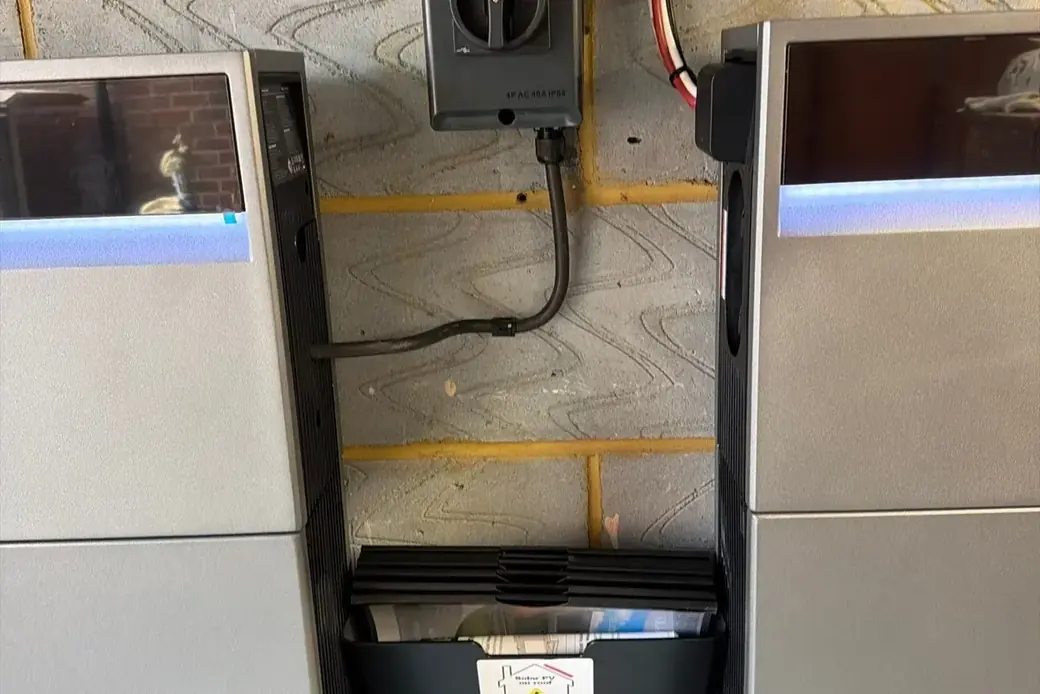
Most retrofits are AC-coupled. The battery arrives with its own inverter, connects to the consumer unit, and monitors the incoming supply through a CT clamp on the meter tails. When the clamp sees surplus heading out to the grid, the battery takes it instead. When it sees import, the battery supplies it.
The advantages are practical. Nothing on the roof is touched, the existing system keeps its certification, and the two halves are independent — if the battery is isolated for service, the solar carries on.
The cost is a round trip. Solar DC becomes AC at the existing inverter, then AC becomes DC again to charge the battery, then back to AC to be used. Each conversion loses a little.
DC coupling avoids that, but only works where the existing inverter is hybrid-capable and supports a battery you would want to buy. Where it does, it is usually the better answer. Where it does not, replacing a working inverter purely for efficiency rarely pays for itself.
Sizing when the array is fixed
With a new system you can move both variables. With a retrofit the array is what it is, so sizing is a question about your surplus and your tariff.
A modest array on a house that is occupied during the day may generate very little surplus, which limits how much a battery fills from solar. That is not necessarily a reason against storage — on a time-of-use tariff the battery can charge overnight at a low rate and cover the expensive part of the day regardless of the weather. But it changes which number drives the sizing, and it is worth being clear about that before you buy capacity.
Notification and certification
The battery adds capacity to the installation, so the network operator is told. Where the combined capacity stays at 16A or less per phase it is a G98 notification after the event; above that it is a G99 application requiring approval before work starts. An existing G98-notified solar system plus a battery of any real size will usually mean a G99.
You get an Electrical Installation Certificate for the new work, updated schedules for the consumer unit, warranty registrations in your name, and the monitoring configured before we leave.
Who this is for
- Homes with solar exporting a large share of what they generate
- Systems installed before storage was common, where the inverter has life left in it
- Households moving to a time-of-use tariff
- Owners who want more from the array they already paid for
What is included, and what is not
Included as standard
- Assessment of the existing array, inverter, metering and consumer unit
- Review of your current export or Feed-in Tariff arrangement before anything changes
- Consumption analysis and capacity sizing against your evening and overnight use
- AC-coupled battery and inverter, or DC coupling where the existing inverter allows it
- Siting, mounting, isolation, protection and cabling
- Consumer unit connection and CT clamp installation for accurate monitoring
- Commissioning, tariff configuration and app setup
- Notification to the network operator and updated electrical certification
Not included
- Repairs to an existing solar system found to be faulty at survey
- Replacement of an existing inverter that is at the end of its life
- Building work to create a suitable location for the battery
- Any change to your existing Feed-in Tariff agreement
Anything in this column that your property turns out to need is identified at survey and priced in the written quotation, not raised later as a variation.
Timescale
Most retrofits are a single day, occasionally two where the cable route or consumer unit needs work.
What affects the cost
| Factor | Why it matters |
|---|---|
| Usable capacity and continuous power output | Assessed at survey and reflected in the fixed written quotation. |
| AC coupling versus DC coupling into a compatible existing inverter | Assessed at survey and reflected in the fixed written quotation. |
| Distance from the battery position to the consumer unit | Assessed at survey and reflected in the fixed written quotation. |
| Condition of the existing board and whether a dedicated way is available | Assessed at survey and reflected in the fixed written quotation. |
| Whether backup or EPS functionality is included | Assessed at survey and reflected in the fixed written quotation. |
| Access and the practicalities of moving a heavy unit into position | Assessed at survey and reflected in the fixed written quotation. |
New to this? Start with how domestic solar works and what battery storage changes, then come back to the detail.
Common questions
Will adding a battery affect my Feed-in Tariff?
It should not stop your payments, but it can change how they are calculated where your export is deemed rather than metered. Deemed export assumes a fixed proportion of generation goes to the grid regardless of what actually happens, so storing more of your own generation does not reduce the payment. The rules depend on your specific agreement, so we ask to see it before quoting.
Do you have to change my existing inverter?
Usually not. An AC-coupled battery has its own inverter and connects on the house side of the meter, so the existing solar inverter carries on unchanged. We only recommend replacing it when it is already near end of life, or when DC coupling would give a meaningful efficiency gain that justifies the work.
My system is fifteen years old. Is it worth adding storage?
Sometimes. The panels are probably still producing respectably, but the inverter may not have long left, and spending on storage just before an inverter failure is poor sequencing. We check the inverter and the array condition first and tell you honestly if the money is better spent elsewhere.
Can the battery be installed by a different company from the original installer?
Yes. We do not need the original installer involved, though the original paperwork helps. What we do need is to test what is there before connecting to it, because we take responsibility for the combined installation once we have worked on it.
Related services
- Battery storage installationHome battery systems sized against your consumption, sited properly and commissioned with the tariff in mind.
- Solar and battery systemsPanels, hybrid inverter and storage designed as one system, on one scaffold, with one commissioning.
- Solar health checkA one-off independent assessment of an existing system, with a written report on its condition and performance.
The technology behind it
- BatteriesHow home storage works, what determines whether it pays, and the specifications that actually matter.
- LFP batteriesLithium iron phosphate chemistry: why it became the domestic standard, and what it gives up in exchange.
- Hybrid invertersA single unit managing array, battery and house demand, and when fitting one is worth the extra cost.
- Monitoring systemsWhat generation, consumption and battery data actually tells you, and what a system needs fitted to produce it.
Property and roof guides
See it on a real installation
Further reading
- Adding a battery to existing solarAC coupling versus replacing the inverter, what a retrofit survey checks, and the network paperwork it can trigger.
- What size battery do I need?How evening consumption, array size, tariff and inverter power rating together decide usable battery capacity.
- The Smart Export Guarantee explainedWhat the SEG obliges suppliers to do, what it does not fix, and what you need in place to apply.
Where we work
Information reviewed on 2026-08-23.
Book a free design and quotation
Tell us about the property and we will arrange a survey, then issue a written design and fixed quotation before any work is agreed.
Enquire about battery retrofit
No obligation. We will review the details, come back to arrange the next step, and issue a written design and fixed quotation before anything is agreed.
Prefer to talk? Call 0118 227 7444.