
Battery Storage
What storage actually changes, how it is sized properly, where it belongs in a house, and why a battery can be worth installing even without solar panels.
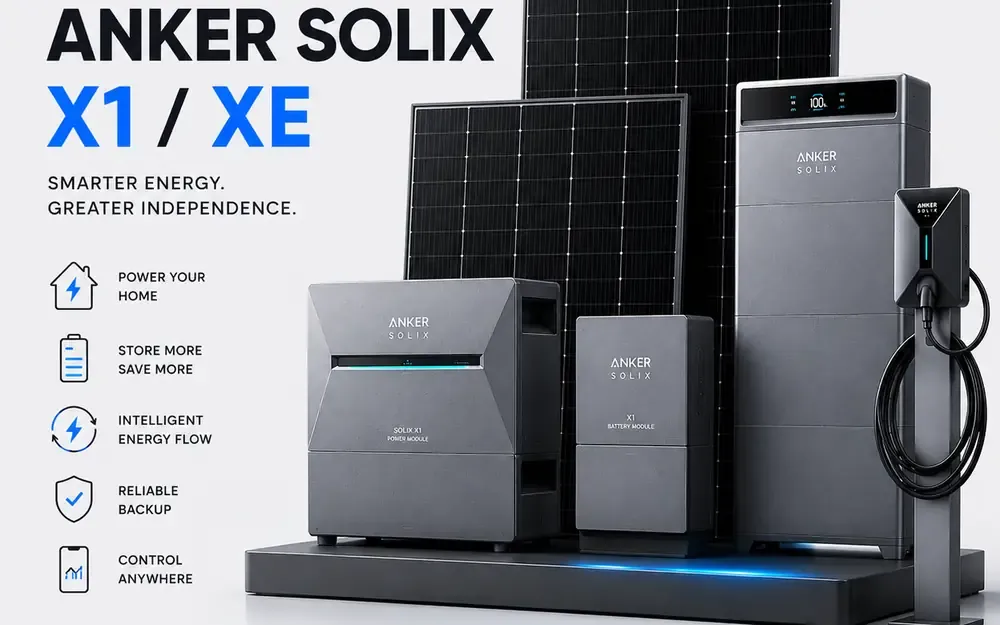
Anker SOLIX X1 / XE — one of the storage systems we install. See the Anker SOLIX X1 page for detail.
Current offer
A free EV charger with every solar panel installation
Fitted at the same time as your panels, on the same scaffold and the same commissioning visit — so the charger is set up to draw from the array rather than fighting it. Ask us for the full terms.
- Installed with your solar
- Load assessment included
- Solar-aware scheduling
We cover roughly two hours around Basingstoke, with Reading as our home patch. Tell us the postcode and we will confirm straight away.
What a battery changes
Solar without storage has an awkward shape. Generation peaks in the middle of the day; household consumption peaks in the evening. If nobody is home between eight and six, most of what the array makes is exported at a low rate and bought back a few hours later at a high one.
A battery closes that gap. It stores what the house is not using and gives it back when the house needs it. That is the whole proposition, and it is why storage often improves the economics of a solar system more than adding another two kilowatts of panels would.
It also does something panels cannot: it lets you buy electricity at one price and use it at another. On a time-of-use tariff, that price difference is worth money by itself — which is why a battery makes sense in houses with no solar at all.
AC-coupled or DC-coupled
There are two ways to connect storage, and which is right depends mostly on whether the solar already exists.
DC-coupled puts the battery on the same side as the panels, managed by a hybrid inverter that handles both. Energy is converted once rather than twice, so it is more efficient. It is the natural choice when solar and storage are installed together — see solar and battery systems.
AC-coupled puts the battery on the house side with its own inverter. It is slightly less efficient, but it does not care what solar system is already there, which makes it the usual answer for a retrofit — see battery retrofit and adding a battery to existing solar.
The inverter architecture is covered properly in hybrid inverters and inverters explained.
Chemistry
Most current home batteries use lithium iron phosphate — LFP. It has a lower energy density than some alternatives, which means a slightly larger box for the same capacity, and in exchange it offers good cycle life and favourable thermal characteristics. For a stationary home battery, where physical size matters much less than it does in a vehicle, that is a sensible trade.
More detail on LFP batteries and battery technology generally.
Sizing it properly
The most common error in battery specification is buying capacity that never gets used. A battery only earns its keep when it cycles — filling and emptying most days. Oversize it and you have paid for kilowatt-hours that sit idle for most of the year.
| Factor | Why it matters |
|---|---|
| Evening and overnight consumption | The load the battery actually has to cover once generation stops. This is the number that sets useful capacity. |
| Surplus generation | What the array produces beyond what the house is using at the time. Without surplus, a solar battery has nothing to store. |
| Tariff | On a time-of-use tariff the battery can be filled cheaply overnight regardless of weather, which changes sizing considerably and makes storage worthwhile in winter. |
| Continuous power output | How much the battery can deliver at once. Capacity is how much; power is how fast. A high-capacity, low-power battery cannot run a shower and an oven together. |
| Peak power output | A short-term rating for start-up loads. Relevant if you have motors, pumps or an induction hob. |
| Round-trip efficiency | Energy lost storing and retrieving. It is never 100%, and DC coupling loses less than AC coupling. |
| Depth of discharge | How far the battery can be emptied without damaging it. Determines usable capacity from nominal. |
Worked through in more detail in battery sizing and what size battery do I need.
Backup and EPS — what it does and does not do
Emergency Power Supply is the function that keeps selected circuits running when the grid goes down. It is not automatic: a battery without EPS shuts down in a power cut along with everything else, for the safety of anyone working on the network.
Where it is specified, it usually covers a subset of circuits rather than the whole house, there is normally a brief interruption while it switches over, and how long it lasts depends on the load and the state of charge. It will not make a house off-grid, and anyone suggesting otherwise is overselling it.
Siting, ventilation and safety
Batteries dislike heat and dislike being difficult to reach. A loft is the worst of both. Where there is any alternative — a garage, a utility space, an external wall in a weatherproof enclosure — we use it.
Siting also covers manufacturer clearances, ventilation, distance from escape routes, the surface the unit stands on or is fixed to, and the practicalities of getting a heavy unit into position. All of it is assessed at survey, not assumed.
Installation and notification
A storage installation involves the battery, its inverter or hybrid inverter, AC and DC isolation, protection, metering and the connection into the consumer unit. As with solar, the network operator is notified: G98 where total generation capacity is 16A or less per phase — about 3.68kW single-phase — and a G99 application requiring approval before installation above that. See G98 and G99 applications.
Warranties and end of life
Battery warranties are more complicated than panel warranties because there are three ways to measure wear: elapsed years, number of cycles, and total energy throughput. A warranty typically expresses all three, whichever comes first — so a battery worked hard on a tariff may reach a throughput limit long before a calendar limit.
Capacity retention is the other term to read: the percentage of original usable capacity the manufacturer undertakes the battery will still have at the end of the term. Warranty terms vary by manufacturer and product, and the terms that apply to your installation are confirmed in your written quotation before work begins. More in warranties explained and on warranties and guarantees.
Cost and value
What drives the price is usable capacity, power output, chemistry and warranty terms, whether a hybrid inverter is needed, whether backup is included, and the siting and electrical work involved. What drives the value is different: it is how often the battery cycles, and the gap between the price you avoid paying and the price you would have been paid for exporting.
Actual generation, savings and payback depend on the property, roof orientation and pitch, shading, system design, your electricity usage and tariff, export rates and future energy prices. Figures shown are estimates and are not guaranteed.
Set out fully on what affects the cost of battery storage.
Storage on real installations
Related services
Battery storage questions
Do I need solar panels to have a battery?
No. A battery on its own can charge from a cheap overnight tariff and discharge through the expensive part of the day, saving money on the price difference alone. It is a different economic case from a solar battery, but a real one — particularly for households with high consumption or an electric car.
What is the difference between usable and nominal capacity?
Nominal is the total energy in the cells. Usable is what you can take out without damaging them. A battery quoted at 10kWh nominal might give you around 9kWh usable. Always compare usable figures, because that is the capacity that does the work.
Will a battery power my house in a power cut?
Only if it is specified with backup or EPS functionality, and usually only for selected circuits rather than the whole house. It is a genuine feature, it needs designing in, it adds cost, and a standard installation does not provide it by default.
Can I add a battery to solar panels I already have?
Usually. It normally means AC coupling, because the existing inverter was not designed to manage a battery. Compatibility, inverter capacity, the condition of the existing installation and any effect on existing warranties all need checking first — which is why we survey before quoting.
How long does a battery last?
Warranties are typically expressed as a number of cycles, a throughput in MWh, or a percentage of capacity retained after a number of years — often all three, whichever comes first. Which measure binds depends on how hard the battery is worked. The specific terms for the product specified for your installation are stated in your written quotation.
Where should the battery go?
Somewhere cool, ventilated and reachable. A garage, utility space or an external wall in a weatherproof enclosure. We avoid lofts wherever there is an alternative: they are the hottest part of the house in summer, and nobody wants to service equipment through a hatch.
Important: Actual generation, savings and payback depend on the property, roof orientation and pitch, shading, system design, your electricity usage and tariff, export rates and future energy prices. Figures shown are estimates and are not guaranteed.
Sources
- Energy-saving materials and heating equipment (VAT Notice 708/6) — HM Revenue & Customs (GOV.UK). Accessed 2026-08-23.
- Smart Export Guarantee (SEG) — Ofgem. Accessed 2026-08-23.
- Distributed Generation Connection Guide: G98 for Single Premises — Energy Networks Association. Accessed 2026-08-23.
Information reviewed on 2026-08-23.
Find out what storage would do in your house
Sizing depends on how you actually use electricity. Tell us the postcode and we will work it out properly.
Get a free battery design and quotation
No obligation. We will review the details, come back to arrange the next step, and issue a written design and fixed quotation before anything is agreed.
Prefer to talk? Call 0118 227 7444.