
Solar Panels
What a domestic solar system is actually made of, what changes its output, what drives the price, and how we design and install one. Written to be useful before you have spoken to anybody.
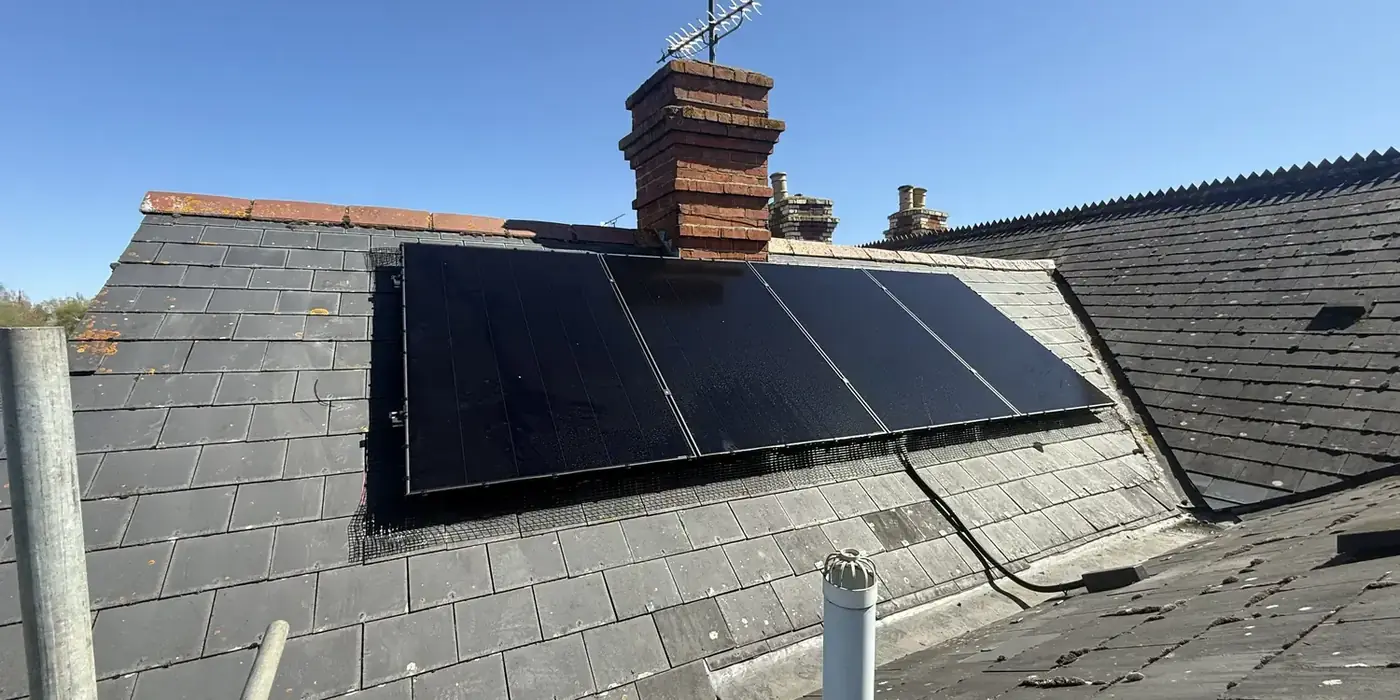
Reading, Berkshire
Twenty panels, one slate roof.
Worked around the chimney and out to the edges of the usable slate, with the FOX EVO equipment kept in the garage rather than the house.
Read the case study →Current offer
A free EV charger with every solar panel installation
Fitted at the same time as your panels, on the same scaffold and the same commissioning visit — so the charger is set up to draw from the array rather than fighting it. Ask us for the full terms.
- Installed with your solar
- Load assessment included
- Solar-aware scheduling
We cover roughly two hours around Basingstoke, with Reading as our home patch. Tell us the postcode and we will confirm straight away.
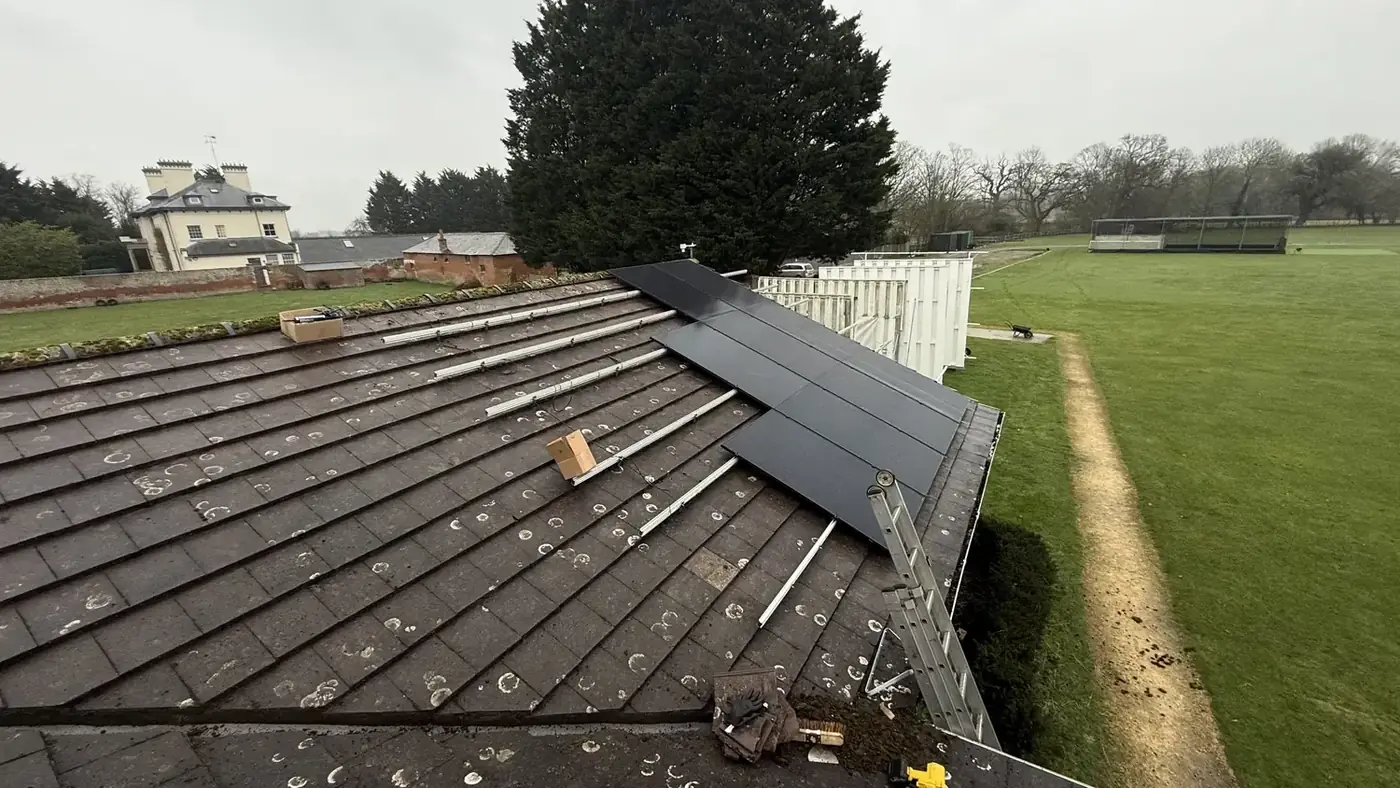
Bath Road, Reading
The rails go down first
The rail run is levelled before a single panel is lifted, because it sets the finished line of the whole array.
From our Bath Road, Reading installation →How a domestic solar PV system works
Solar panels generate direct current when daylight falls on them — not heat, daylight, which is why they work on an overcast January afternoon, just less well. That DC electricity goes to an inverter, which converts it to the alternating current your house runs on and feeds it into the consumer unit.
From there it behaves like any other electricity in the house. Whatever is running at the time uses it first. Anything left over goes to a battery if you have one, and anything beyond that is exported to the grid.
The whole economic case rests on one distinction: electricity you use yourself is worth what you would otherwise have paid for it, and electricity you export is worth considerably less. Everything else — sizing, orientation, storage, tariffs — is really about shifting the balance between those two.
What a system is made of
| Component | What it does |
|---|---|
| Panels | Convert daylight into DC electricity. Efficiency, temperature coefficient and degradation rate are the figures worth comparing. |
| Mounting system | Rails and fixings that transfer the load into the roof structure. Fixings go into rafters, not battens. |
| Inverter | Converts DC from the array into AC the house can use. String, hybrid, microinverter or optimiser architectures each suit different roofs. |
| Optimisers | Per-panel electronics that limit the effect of shading on the rest of a string. Worth their cost under partial shading, not otherwise. |
| Isolation | DC isolation at the array and inverter, AC isolation on the house side, so the system can be shut down safely. |
| Generation meter | Records what the array produces, separately from what the house imports or exports. |
| Monitoring | Shows generation, consumption and export, and is how an underperforming system gets noticed early. |
Each of these is covered in more depth in the technology section, including where each inverter architecture is genuinely the better choice.
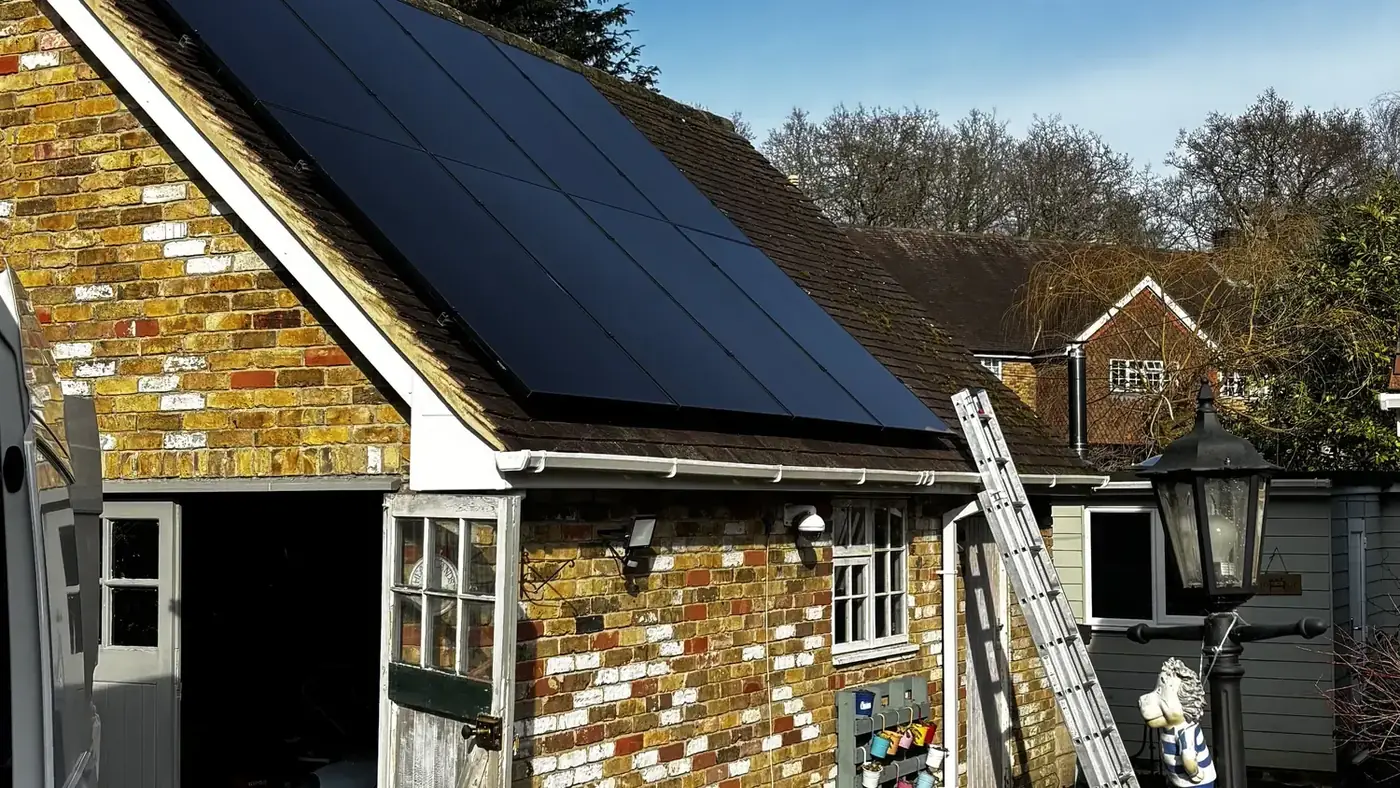
Tadley, Hampshire
Clay tile asks more of the fixings
Twenty-four Renusol hooks, each one placed rather than approximated, so every tile beds back down over it.
From our Tadley, Hampshire installation →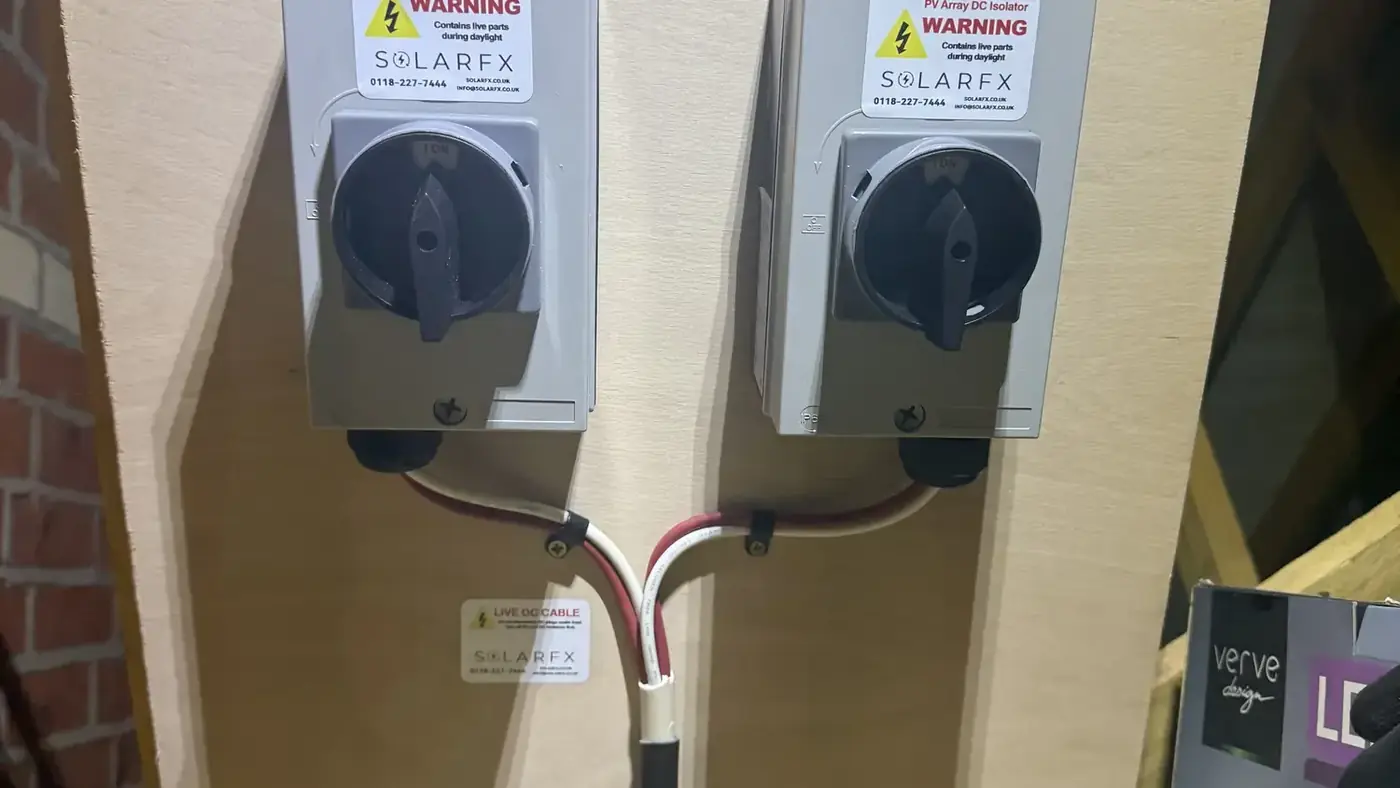
Reading, Berkshire
Isolation, labelled
PV DC isolation fitted and marked up, with the cabling clipped rather than left to hang.
From our Reading, Berkshire installation →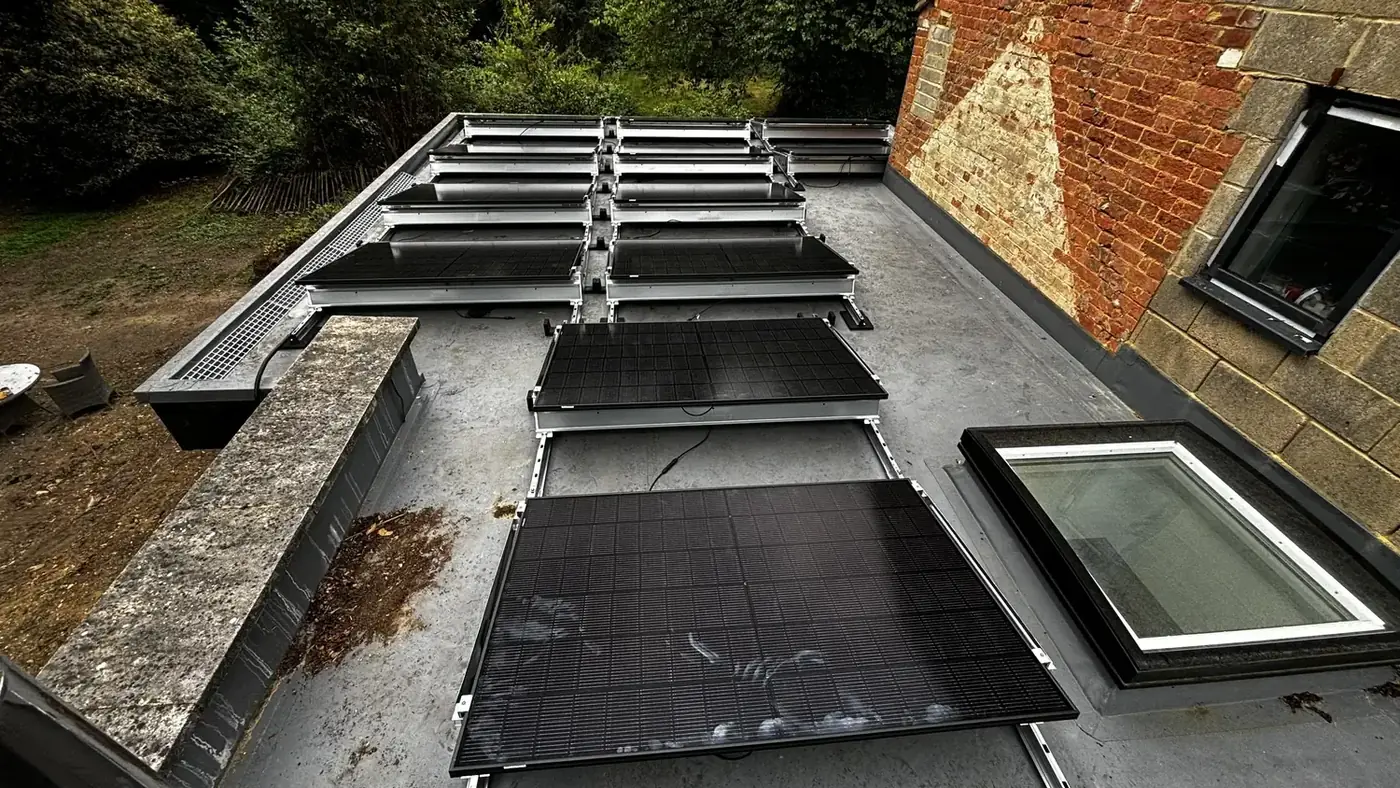
Tadley, Hampshire
On a flat roof the frame is the design
Row spacing decides whether the front rank shades the one behind it through the winter.
From our Tadley, Hampshire installation →Sizing: start with consumption, not the roof
System size is quoted in kWp — kilowatts peak — which is the output of the array under standard test conditions. It is a comparison figure rather than a promise; a 4kWp array does not produce 4kW for most of the day.
The common mistake is to size against roof area. Fill a large roof on a house that uses very little during the day and most of that generation is exported at a low rate. We size against your actual consumption pattern, which means asking what you use, when you use it, and whether anybody is home.
Orientation and pitch
South-facing gives the highest annual total. East and west produce less overall but spread it across the morning and evening, which frequently suits a household better and pairs well with storage. Pitch affects the seasonal curve: a steeper roof does relatively better in winter when the sun is low, a shallow roof relatively better in midsummer.
There is more detail in roof orientation and shading and solar on east-west roofs.
Shading
Shading is the factor most often assessed badly, because it changes through the day and through the year. A roof that is clear in June can lose two hours to a neighbour's chimney in December. Where shading is unavoidable, per-panel electronics limit the damage to the rest of the array — but they are a mitigation, not a cure, and on a heavily shaded roof the honest answer is sometimes that the roof is the wrong site.
The roof itself
Roof covering determines the fixing method. Concrete and clay tiles take a hook set into the rafter with the tile relieved so it sits back down flat. Slate is brittle and needs a different, more careful approach. Metal and profile sheet roofs use clamps or through-fixings depending on the seam. Flat roofs need a ballasted or mechanically fixed frame that raises the panels to an angle — a different job again.
Roof condition matters as much as covering. Putting a twenty-five year array on a roof with five years left in it creates an expensive problem later. If we think the roof should be dealt with first, we will say so — see removal and refit for roof works.
Property age is the other variable: homes built before 1920, 1920 to 1965 and post-1965 each bring different structures, coverings and electrical arrangements.
In-roof or on-roof
On-roof mounting sits the array above the tiles on rails. It is the standard approach, it is less expensive, and it can be retrofitted to almost any suitable roof.
In-roof mounting replaces a section of the covering with an integrated tray so the panels sit flush with the tile line. It costs more, it is far easier during a re-roof than as a retrofit, and in a conservation area or on a prominent elevation it is sometimes the difference between a scheme that suits the building and one that does not. Compared properly in in-roof versus on-roof solar.
The electrical side
Around the array sit the parts that make it safe and serviceable: DC isolation at the array and at the inverter, AC isolation, over-current protection, a generation meter and labelling that tells the next electrician what they are looking at.
The existing installation matters. On older properties it is common to find a consumer unit that is serviceable but full, or one due replacement anyway, and earthing arrangements that need attention. We assess this at survey and price it into the fixed quotation rather than raising it as a variation on the day.
Notification, certification and consent
DNO notification. Where total generation capacity is 16A or less per phase — about 3.68kW on a normal single-phase supply — the installation is notified to the network operator under G98 within 28 days of commissioning. Above that threshold a G99 application must be made and approved before installation, which takes time and has to be planned for. See G98 and G99 explained.
MCS. The installation is certified under MCS, which covers both the products and the installer. You need it to apply for an export tariff. See what MCS certification means.
Planning. Roof solar on residential buildings may be permitted development subject to limits and conditions. Listed buildings, conservation areas and World Heritage Sites carry additional restrictions and may require consent. See do you need planning permission and listed buildings and conservation areas.
Export, VAT and what the numbers depend on
The Smart Export Guarantee obliges larger licensed electricity suppliers to offer an export tariff. Suppliers set their own rate, contract length and terms — Ofgem does not set the rate — and rates must be above zero. Certification is required to qualify. See the Smart Export Guarantee explained.
VAT. Installation of qualifying energy-saving materials in residential accommodation in Great Britain is zero-rated from 1 May 2023 to 31 March 2027, reverting to the 5% reduced rate from 1 April 2027. Electrical storage batteries were added to the qualifying list from 1 February 2024. See VAT on solar panels.
Actual generation, savings and payback depend on the property, roof orientation and pitch, shading, system design, your electricity usage and tariff, export rates and future energy prices. Figures shown are estimates and are not guaranteed.
What that means in practice is set out in what affects the cost of solar panels and how payback is calculated.
Maintenance and lifespan
Panels need very little. The parts that need attention are the ones people forget: isolators, connectors, clamps and the inverter, which is the component most likely to need replacing within the life of the array. Birds nesting under panels are a common and avoidable problem.
Covered in maintenance and servicing, cleaning, bird proofing and inverter replacement.
How we install
Survey, remote design, site survey, final design and fixed quotation, permissions and DNO, installation, then commissioning and handover with the certification pack. The full sequence is on how Solar Fx works, and the standards we hold the work to are on our installation standards.
Many domestic installations are completed in one to three days once scaffolding is in place, although the actual duration depends on system size, roof type, access, electrical works and whether a battery is included.
See it on a real installation
Where we install
Solar panel questions
How many panels will fit on my roof?
Fewer than the roof area suggests, almost always. Panels must keep clear of ridges, hips, valleys, verges and vent tiles, and the layout has to line up with the rafters underneath. We measure the roof at survey and give you the real number rather than one calculated from a footprint.
Do I need planning permission?
For most houses, roof-mounted solar is permitted development subject to limits and conditions. Listed buildings, conservation areas and World Heritage Sites carry additional restrictions and may require consent. We check the designation for your address before designing anything.
What is MCS and do I need it?
MCS is the standards scheme covering both products and installers for small-scale renewables. You need an MCS-certified installation to qualify for a Smart Export Guarantee tariff, so in practice it matters for more than the paperwork.
Will solar work on an east or west facing roof?
Yes. South produces the highest annual total, but east and west arrays spread generation across the morning and evening, which often matches household consumption better — particularly with a battery. A north-facing roof is a different matter and we will tell you honestly when it is not worth doing.
How long do panels last?
Panels degrade slowly and predictably, and manufacturers publish both a product warranty and a separate performance warranty describing expected output over time. The specific terms depend on the product specified for your installation and are stated in your written quotation.
Do I need scaffolding?
For anything above single storey, yes. It is a safety requirement rather than a preference, and it is usually the largest non-equipment cost on a domestic installation.
Important: Actual generation, savings and payback depend on the property, roof orientation and pitch, shading, system design, your electricity usage and tariff, export rates and future energy prices. Figures shown are estimates and are not guaranteed.
Sources
- Energy-saving materials and heating equipment (VAT Notice 708/6) — HM Revenue & Customs (GOV.UK). Accessed 2026-08-23.
- Smart Export Guarantee (SEG) — Ofgem. Accessed 2026-08-23.
- Smart Export Guarantee — Consumers — MCS. Accessed 2026-08-23.
- Distributed Generation Connection Guide: G98 for Single Premises — Energy Networks Association. Accessed 2026-08-23.
- Solar panels — planning permission — Planning Portal. Accessed 2026-08-23.
- Solar photovoltaic (PV) — Consumers — MCS. Accessed 2026-08-23.
Information reviewed on 2026-08-23.
Find out what your roof can actually do
A free survey, a written design and a fixed quotation — before you commit to anything.
Get a free solar design and quotation
No obligation. We will review the details, come back to arrange the next step, and issue a written design and fixed quotation before anything is agreed.
Prefer to talk? Call 0118 227 7444.