
Technology
Hybrid Inverters
A single unit managing array, battery and house demand, and when fitting one is worth the extra cost.
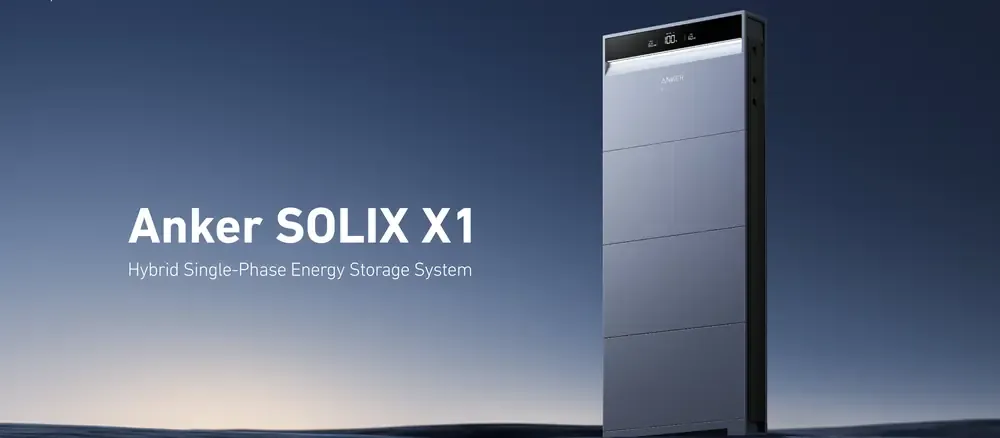
Product image supplied by Anker SOLIX. A hybrid system managing array, battery and household demand in one unit.
What a hybrid inverter is
A string inverter with a battery port and the control logic to decide where energy should go. Instead of one box converting solar and a second box charging a battery, one unit handles the array, the battery, the house and the grid connection together.
The control logic is the point. At any moment the unit is deciding whether to send array output to the house, to the battery or to export, whether to discharge the battery to cover demand, and whether to import from the grid to charge. Those decisions are what turn a battery from a piece of hardware into a saving.
How it works
Solar arrives on the DC side through one or more MPPT inputs. A Maximum Power Point Tracker adjusts the operating voltage of the array it is connected to, hunting for the point where voltage multiplied by current is greatest, and re-checking constantly as light and temperature change. As on any string inverter, everything on one tracker shares one operating voltage, so separate roof orientations need separate trackers.
The battery connects on its own DC port. Because both the array and the battery are on the DC side, solar charging happens with a single conversion. An AC-coupled system converts DC to AC and then back to DC to charge, and loses a few per cent to that round trip.
Grid charging works the other way: the unit imports at a time you set, converts to DC and fills the battery. On a tariff with a cheap overnight window this is often worth more than the solar charging, particularly in winter.
Where it is used
New solar-and-battery installations, where fitting one unit rather than two is both cheaper and simpler. Installations where a battery is planned for a later phase but the wiring and inverter should be ready. Larger systems where the tariff control and load management matter as much as the generation.
It is less commonly the right answer as a retrofit to existing solar, because that means removing an inverter that works. In that case AC coupling a separate battery inverter usually makes more sense.
Suitability and limitations
A hybrid is the right choice when storage is part of the plan. It is the wrong choice for a household that will never fit a battery, because the extra cost buys capability that sits idle.
The commitment to think about is compatibility. The battery must come from the inverter manufacturer’s approved list, and high-voltage and low-voltage battery architectures are not interchangeable. That constrains what you can add in five years’ time, so the sensible approach is to specify against the capacity you might eventually want rather than only the capacity you are buying.
Installation implications
A hybrid needs siting near both the array cabling and the battery, which usually means a garage, utility or plant space rather than a loft. Batteries have their own temperature and location requirements, and putting the pair somewhere that suits both takes some thought at survey.
If backup during an outage is wanted, it must be designed in. That means deciding which circuits are backed up, wiring a changeover arrangement, and accepting that the backup output has a capacity limit — it will not necessarily run an electric shower or a heat pump.
The DNO position also changes. A system with storage may cross the threshold from G98 notification to a G99 application requiring approval before installation, which affects the programme.
Cost and warranty
A hybrid costs more than a plain string inverter of the same rating, and less than a string inverter plus a separate battery inverter. The comparison worth making is against your own likely path: fitting a hybrid now against fitting a string inverter now and AC coupling later.
Warranty terms for the inverter and for the battery are separate, and the battery’s terms will usually reference a throughput or cycle limit as well as a period. Both datasheets come with the written quotation.
Specification considerations
These are the figures worth comparing when you are reading a quotation. The exact values for the products specified for your installation come from the manufacturer's current datasheet and are stated in your written quotation.
| What to look at | Why it matters |
|---|---|
| Function | Converts array DC to AC and manages battery charge and discharge in one unit |
| Coupling | DC-coupled — solar charges the battery without a separate AC conversion step |
| MPPT inputs | Typically two or more solar trackers plus a separate battery port |
| Battery compatibility | Restricted to batteries on the manufacturer's approved list; not interchangeable |
| Battery voltage | High-voltage or low-voltage battery architecture, decided by the inverter — the two are not mixable |
| Backup capability | Many units support a backup output, which requires a changeover arrangement wired at installation |
| Tariff control | Supports timed charging from the grid to make use of off-peak import rates |
Where it works, and where it does not
Strengths
- One unit and one app for solar, battery and grid rather than two separate systems
- Solar charges the battery on the DC side, avoiding the conversion losses of an AC-coupled arrangement
- Timed grid charging lets a battery be filled on a cheap overnight rate and used across the peak
- Backup supply during an outage is available on many units where the wiring is arranged for it at installation
- One point of contact for warranty on the conversion and storage electronics together
Limitations
- Costs more than a plain string inverter, so it is wasted money if a battery will genuinely never be fitted
- Ties the battery choice to that manufacturer's approved list, reducing future flexibility
- Still a single point of failure — a fault takes solar and storage out together
- Battery capacity is bounded by what the unit supports, which can constrain later expansion
- Retrofitting one to an existing solar system means replacing a working inverter
This page covers one component. For how the whole thing fits together, see solar panels and battery storage.
Common questions
Should I fit a hybrid if I am not having a battery yet?
It depends on how likely the battery is. If you expect to add storage within a few years, fitting a hybrid now avoids replacing a working inverter later and generally costs less overall. If storage is a vague maybe, a standard string inverter plus AC coupling later is a reasonable path and avoids paying for capability you may never use. We will price both so the difference is visible.
What is the difference between DC and AC coupling?
A DC-coupled hybrid takes solar DC and sends it straight to the battery with one conversion. An AC-coupled arrangement converts solar to AC, then a separate battery inverter converts it back to DC to charge. That extra round trip loses a few per cent. DC coupling is more efficient; AC coupling is better when you already have a working solar inverter and do not want to replace it.
Will a hybrid keep my house running in a power cut?
Only if it is specified and wired for that. Many hybrids support a backup output, but it needs a changeover arrangement and a defined set of circuits, decided before installation. It typically powers selected circuits rather than the whole house, and the transfer is not always seamless. Ask for it explicitly at design stage rather than assuming it comes with the unit.
Can I use any battery with a hybrid inverter?
No. Each hybrid works with a specific approved battery list, and the high-voltage and low-voltage architectures are not interchangeable. This is the main long-term commitment a hybrid involves, so we check that the pairing supports the capacity you may eventually want, not just the capacity you are fitting now.
Related services
- Solar and battery systemsPanels, hybrid inverter and storage designed as one system, on one scaffold, with one commissioning.
- Battery storage installationHome battery systems sized against your consumption, sited properly and commissioned with the tariff in mind.
- Battery retrofitAdding storage to a solar system that is already on the roof, without disturbing what works.
- Inverter replacementReplacing a failed or ageing inverter, matched to the array that is already on the roof.
The technology behind it
- InvertersWhat the inverter does, how MPPT works, and how the four architectures compare honestly against each other.
- String invertersThe conventional central inverter: how strings are designed, where it is the best value, and where it is the wrong choice.
- BatteriesHow home storage works, what determines whether it pays, and the specifications that actually matter.
- LFP batteriesLithium iron phosphate chemistry: why it became the domestic standard, and what it gives up in exchange.
- Battery sizingHow storage capacity and power rating are calculated from consumption data rather than from roof size.
Property and roof guides
- Post-1965 homesTrussed rafter roofs, concrete interlocking tile and modern electrics — the most straightforward housing stock to work on.
- New build homesRetrofitting or extending solar on a new build — structural warranty notification, shallow pitches, interrupted roof planes and covenants.
- BungalowsLarge roof area over a small floor plan, low eaves and easy access — with shading and consumption as the real limits.
See it on a real installation
- Solar, storage and EV charging in Padworth, BerkshireA whole-home energy system on an established tiled roof — solar PV, battery storage, EV charging and a surplus diverter for hot water.
- A battery upgrade that became a full system rebuild, East HorsleyThe enquiry was for another 15kWh of storage. The survey found four roof orientations sharing two MPPTs, and the honest answer was to rebuild from the roof upwards.
Further reading
- Adding a battery to existing solarAC coupling versus replacing the inverter, what a retrofit survey checks, and the network paperwork it can trigger.
- What size battery do I need?How evening consumption, array size, tariff and inverter power rating together decide usable battery capacity.
- String inverter vs microinvertersHow central and module-level conversion differ in shading tolerance, servicing, monitoring and failure behaviour.
Where we work
Information reviewed on 2026-08-23.
Not sure which specification suits your roof?
We design around the property rather than fitting the same system to every house. Tell us the postcode and we will explain what we would specify and why.
Ask us about specification
No obligation. We will review the details, come back to arrange the next step, and issue a written design and fixed quotation before anything is agreed.
Prefer to talk? Call 0118 227 7444.