
Technology
Solar Monitoring Systems
What generation, consumption and battery data actually tells you, and what a system needs fitted to produce it.
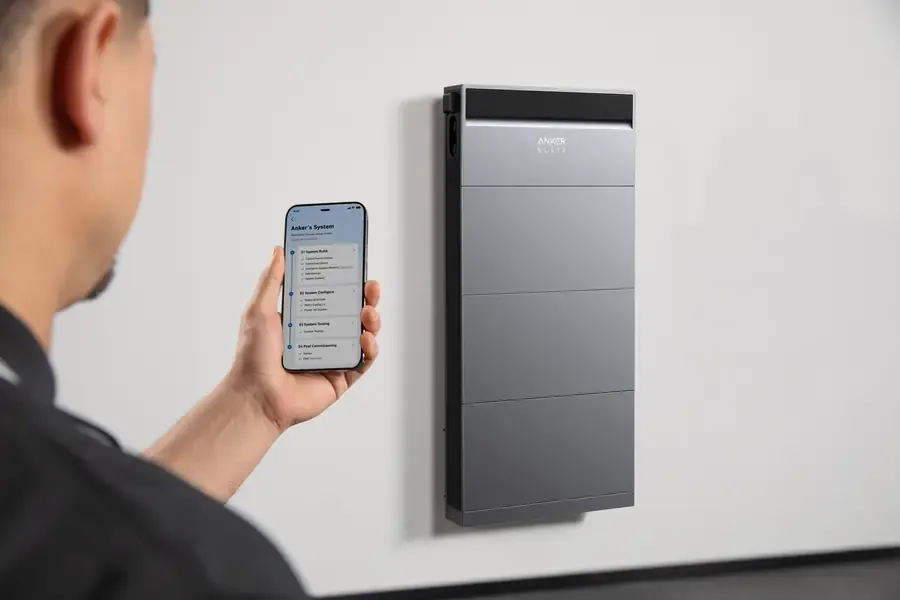
Manufacturer image supplied by Anker SOLIX. Commissioning and monitoring through the installer app.
What monitoring is for
Two things. Confirming the system does what it was designed to do, and telling you when it stops.
Solar is a quiet technology. There is no noise, no vibration and no obvious symptom when something fails. A string can drop out, an optimiser can fail, a panel can develop a fault, and the array will carry on producing a plausible-looking amount of electricity while quietly losing a fifth of its output. Without data nobody notices until the annual bill looks wrong, and by then a year of generation has gone.
Where the data comes from
The inverter is the primary source. It knows what the array delivered, at what voltage and current, on each of its MPPT inputs, and it logs faults.
That is only half the picture. The inverter does not know what your house consumed, how much you imported or how much you exported, because none of that passes through it. Seeing those requires a current transformer or meter clamped at the incoming supply, reporting alongside the inverter.
The distinction matters because generation data on its own answers almost none of the questions people actually have. Knowing you produced 14kWh is interesting. Knowing you produced 14kWh, used 6kWh of it and exported 8kWh tells you whether a battery is worth fitting.
Where a battery is installed, the system also reports charge, discharge and state of charge, which is what lets you check that tariff-timed charging is behaving as intended.
Levels of detail
Inverter level. Total generation, per-string or per-tracker figures, and fault codes. Standard on every system. Enough to identify a failed string or an inverter fault.
Panel level. Available only where microinverters or optimisers are fitted, because those are the devices that report per module. It shows exactly which panel is down or shaded, which turns a diagnostic visit into a phone call.
Panel-level data is a real benefit of per-panel electronics. It is not on its own a sufficient reason to fit them on a clear, simple roof, where the additional cost buys monitoring detail you will rarely need.
Where it is used
Every system we install is commissioned with monitoring configured and demonstrated at handover, including consumption metering. We also set it up on systems installed by others, which is normally the first step of a health check — a system with no data history is one where every fault has to be diagnosed on site from scratch.
Suitability and limitations
The main practical constraint is connectivity. Inverters sit in lofts, garages and outbuildings, frequently at the far edge of a home Wi-Fi network. An intermittent connection produces missing days that look identical to a fault, and it undermines the alerting that makes monitoring useful.
The second constraint is that data lives in the manufacturer’s portal. Retention periods, export formats and the quality of the app vary considerably between products, and changing inverter manufacturer generally means starting a new history.
Installation implications
Consumption metering is fitted at the incoming supply, which means working at the meter position and routing a small cable back to the inverter or a gateway. It is straightforward during installation and disruptive afterwards, which is why it should be specified from the start.
Signal strength is checked at survey, not discovered at commissioning. Where it is marginal we run Ethernet, fit a repeater or specify a cellular option.
Warranty, cost and getting value from it
Monitoring hardware is generally covered under the inverter warranty; the portal or app is a service the manufacturer provides and its terms can change over the system life. Some manufacturers charge for extended data retention or for advanced features.
The cost at installation is small — the metering hardware and the commissioning time. The value depends entirely on whether anyone looks. The most useful habit is not checking daily but comparing each month against the same month last year, because that is where slow decline shows up while it is still worth fixing.
Specification considerations
These are the figures worth comparing when you are reading a quotation. The exact values for the products specified for your installation come from the manufacturer's current datasheet and are stated in your written quotation.
| What to look at | Why it matters |
|---|---|
| Data source | The inverter reports generation; consumption and export need a separate current transformer or meter at the supply |
| Granularity | Inverter-level as standard; panel-level only where microinverters or optimisers are fitted |
| Connection | Wi-Fi, Ethernet or a cellular dongle, depending on the unit and the distance to the router |
| Typical metrics | Generation, house consumption, import, export, and battery charge, discharge and state of charge |
| Interval | Live figures updated in near real time, with historical data usually held at daily and monthly resolution |
| Data retention | Held in the manufacturer's portal; retention periods and export formats vary by product |
| Alerting | Fault and zero-generation alerts, where the product supports them and they have been enabled |
Where it works, and where it does not
Strengths
- Shows whether the system is producing what the design predicted, rather than leaving you to guess
- Consumption metering reveals how much generation you actually use versus export, which drives battery decisions
- Identifies a fault or a drop in output early, before a season of lost generation goes unnoticed
- Panel-level data pinpoints a single failing or soiled module without a site visit
- Provides the evidence needed to make a warranty claim or to justify a repair
Limitations
- Generation data alone tells you very little without consumption data alongside it
- Panel-level detail requires microinverters or optimisers; a plain string system cannot provide it
- Depends on a network connection, and a marginal Wi-Fi signal in a loft is a common cause of gaps
- Data lives in the manufacturer's portal, so it is tied to that product and its retention policy
- Alerts only help if someone reads them; most underperformance we find had been visible in the data for months
This page covers one component. For how the whole thing fits together, see solar panels and battery storage.
Common questions
Will I be able to see my electricity usage as well as generation?
Only if consumption metering is fitted. The inverter knows what the array produced; it does not know what the house did with it unless a current transformer or meter is installed at the incoming supply. That extra metering is inexpensive at installation and awkward to add later, so we include it as standard rather than as an option.
Can I see how each panel is performing?
Only with microinverters or optimisers, which report per module. A plain string system reports at inverter or string level, which is enough to spot a whole-string fault but not enough to identify one weak panel. That is a genuine reason to choose per-panel electronics on a difficult roof, and not a reason on a simple one.
What does underperformance look like in the data?
Usually a clean shape rather than a dramatic drop: a string that starts later in the morning than it used to, an afternoon curve with a notch in it that was not there last year, or a total that is consistently a fixed percentage below the same month previously. Sudden zeros are easy. Slow decline is what goes unnoticed, which is why an annual look at the data is worth more than a daily glance at the app.
Does monitoring need my home Wi-Fi?
Usually, and signal strength at the inverter is the thing to check. Inverters often sit in lofts or garages at the edge of coverage, and an intermittent connection produces gaps that look like faults. Where the signal is poor we run a cable, fit a repeater or use a cellular dongle rather than leaving it to chance.
Related services
- System monitoring and optimisationGetting proper data out of a system, then changing its settings so it earns more from the same hardware.
- Solar health checkA one-off independent assessment of an existing system, with a written report on its condition and performance.
- Solar panel maintenanceScheduled servicing of the whole system — array, fixings, DC side, inverter and monitoring — not just the glass.
- Solar panel repairsFault diagnosis and repair on arrays that have stopped working, or never quite worked properly.
The technology behind it
- InvertersWhat the inverter does, how MPPT works, and how the four architectures compare honestly against each other.
- MicroinvertersOne inverter per panel mounted on the roof: what per-panel conversion buys, and what it costs.
- Power optimisersPer-panel DC electronics that keep conversion in one accessible box: the middle option between string and micro.
- BatteriesHow home storage works, what determines whether it pays, and the specifications that actually matter.
- String invertersThe conventional central inverter: how strings are designed, where it is the best value, and where it is the wrong choice.
Property and roof guides
See it on a real installation
- A complete home energy system in Reading, BerkshireTen panels across a pitched garage roof, battery storage against the wall below, and an EV charger — designed as one system rather than three separate jobs.
- A battery upgrade that became a full system rebuild, East HorsleyThe enquiry was for another 15kWh of storage. The survey found four roof orientations sharing two MPPTs, and the honest answer was to rebuild from the roof upwards.
Further reading
- Signs your solar system is underperformingHow to tell a genuine fault from normal seasonal variation, and the checks worth doing before calling anyone out.
- What size battery do I need?How evening consumption, array size, tariff and inverter power rating together decide usable battery capacity.
- Solar panel degradation and lifespanHow panel output declines gradually over time, which components have shorter lives, and what determines how long a system lasts.
Where we work
Information reviewed on 2026-08-23.
Not sure which specification suits your roof?
We design around the property rather than fitting the same system to every house. Tell us the postcode and we will explain what we would specify and why.
Ask us about specification
No obligation. We will review the details, come back to arrange the next step, and issue a written design and fixed quotation before anything is agreed.
Prefer to talk? Call 0118 227 7444.