
Technology
Solar Inverters
What the inverter does, how MPPT works, and how the four architectures compare honestly against each other.
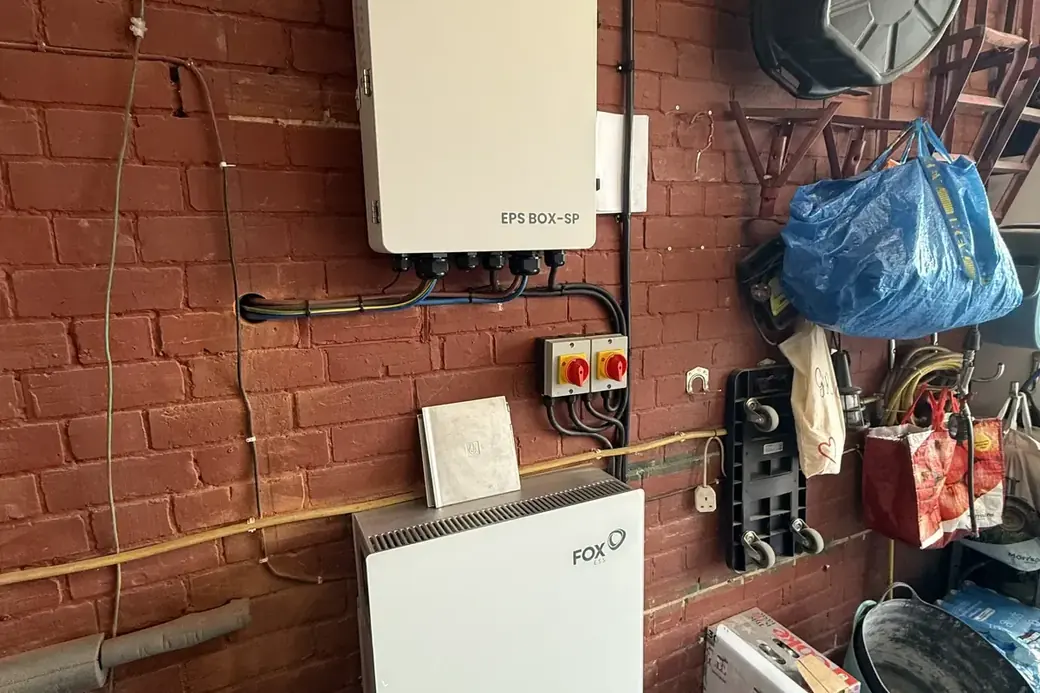
What the inverter does
Panels produce direct current at a voltage that rises and falls with light and temperature. Your house runs on 230V alternating current, and the grid will only accept electricity that matches its voltage, frequency and phase closely. The inverter does that conversion and that matching, and it disconnects automatically if the grid supply disappears.
It is also the part of the system that thinks. Everything else in a solar installation is passive.
How MPPT works
At any instant an array has one operating point where the product of voltage and current is at its maximum. Draw at a lower voltage and current is high but voltage is wasted; draw at a higher voltage and current collapses. That peak moves continuously — with cloud, with time of day, with panel temperature.
A Maximum Power Point Tracker sweeps the operating voltage and settles on the peak, then keeps re-checking. This is why an inverter’s number of independent MPPT inputs matters more than most specification sheets suggest.
Everything wired to one tracker is held at the same operating voltage. If a south slope and an east slope share a tracker, the tracker finds one compromise voltage, and both arrays run away from their own optimum for most of the day. Split them across two trackers and each finds its own peak. The same logic applies to any group of panels behaving differently from its neighbours — including a shaded group.
The four architectures, compared honestly
String inverter
All panels wired in series into one or more strings, one central box doing the conversion. The lowest cost per watt, the fewest components, the simplest fault-finding, and one unit to replace in fifteen years. On an unshaded roof of one or two orientations, this is usually the right answer and the best value. Its weakness is that a series string is limited by its weakest panel, and it is a single point of failure.
Hybrid inverter
A string inverter with battery management built in. Manages array, battery and house demand in one unit rather than two. The sensible choice when a battery is being fitted now, or is genuinely likely later. It costs more than a plain string inverter, so it is not the right answer for someone who will never add storage.
Microinverters
One small inverter per panel, mounted on the roof. Each panel converts independently, so shading on one affects only that one, and there is no high-voltage DC on the roof. They cost considerably more per watt and put electronics under the array where reaching a failed unit means scaffolding. They earn that cost on genuinely difficult roofs: heavy or complex shading, several small arrays at different orientations, awkward geometry.
String inverter with power optimisers
A middle position. Each panel gets a small DC-DC device that lets it operate independently within the string, while conversion stays in one accessible box. Recovers most of what shading takes, costs less than microinverters, but still adds a device per panel on the roof.
Suitability
The honest summary: unshaded, one or two orientations, no battery planned — string inverter. Battery now or likely — hybrid. Partial shading you cannot design out — optimisers. Severe shading, fragmented arrays, or a preference for no DC on the roof — microinverters. Paying for per-panel electronics on a clear roof buys nothing.
Installation, warranty and cost
Siting drives longevity. Heat shortens electronic life, so a hot loft is a compromise; a garage or a shaded external wall is usually better. All units need clearance for airflow and access for service.
Inverter warranties are shorter than panel warranties and vary widely by product, with extensions often available at purchase. Because the inverter is the component most likely to need replacing, that term is worth reading properly. The specific length, the conditions attached, and the price of any extension are stated on the datasheet and in your written quotation.
Specification considerations
These are the figures worth comparing when you are reading a quotation. The exact values for the products specified for your installation come from the manufacturer's current datasheet and are stated in your written quotation.
| What to look at | Why it matters |
|---|---|
| Function | Converts DC from the array into 230V AC synchronised with the grid supply |
| Architectures | String, hybrid, microinverter and string-plus-optimiser |
| MPPT inputs | Typically one to three independent trackers on a domestic string or hybrid unit |
| Typical efficiency | Peak conversion efficiency is high across all mainstream units; compare the weighted figure, not the peak |
| Grid compliance | Must be a type-tested unit listed under the relevant G98 or G99 requirements |
| Typical service life | Shorter than the panels — the inverter is usually the first component to need replacement |
| Siting | Loft, garage, utility or external wall, depending on the unit's temperature and ingress rating |
Where it works, and where it does not
Strengths
- Converts array output into electricity the house can use and the grid will accept
- MPPT tracking continuously adjusts array operating voltage to extract the available power as conditions change
- Provides monitoring data on generation, and on consumption and battery flow where metering is fitted
- Handles automatic disconnection when the grid supply fails, which is a safety requirement
Limitations
- The component most likely to fail or need replacing within the system life
- A single string or hybrid unit is a single point of failure for the whole array
- Undersized MPPT inputs force mismatched roof orientations onto one tracker, which costs output
- Roof-level architectures remove the single point of failure but put electronics where they are expensive to reach
This page covers one component. For how the whole thing fits together, see solar panels and battery storage.
Common questions
What is MPPT and why does it matter?
A Maximum Power Point Tracker continuously adjusts the voltage at which it draws from the array to find the point where voltage multiplied by current is greatest. That point moves constantly with light and temperature. It matters for design because everything connected to one tracker is held at one operating voltage — so putting an east slope and a west slope on the same tracker means neither runs at its own optimum, and the array loses output whenever the two slopes disagree.
How many MPPT inputs do I need?
One per roof orientation, as a rule. A single south-facing array needs one. An east-west split needs two. A house with south and west slopes plus a small dormer array needs three, or a different architecture. This is one of the first things we check when sizing an inverter, and it is a common shortcoming in quotations we are asked to review.
Where does the inverter go?
Somewhere ventilated, accessible and within a reasonable cable run of both the array and the consumer unit. Lofts are common but get hot, which shortens life and can cause the unit to reduce output on the hottest days. A garage or utility is usually better where the cable run allows. Some units are rated for external mounting.
Will my solar work in a power cut?
By default, no. Grid-connected inverters are required to disconnect when the supply fails, so that they do not energise a network that someone may be working on. Backup during an outage requires specific equipment and a changeover arrangement, and it is a design decision to make before installation rather than after.
Related services
- Solar panel installationSurvey, design, roof works, electrical works and commissioning for a domestic solar PV system.
- Inverter replacementReplacing a failed or ageing inverter, matched to the array that is already on the roof.
- Solar and battery systemsPanels, hybrid inverter and storage designed as one system, on one scaffold, with one commissioning.
- System monitoring and optimisationGetting proper data out of a system, then changing its settings so it earns more from the same hardware.
The technology behind it
- String invertersThe conventional central inverter: how strings are designed, where it is the best value, and where it is the wrong choice.
- Hybrid invertersA single unit managing array, battery and house demand, and when fitting one is worth the extra cost.
- MicroinvertersOne inverter per panel mounted on the roof: what per-panel conversion buys, and what it costs.
- Power optimisersPer-panel DC electronics that keep conversion in one accessible box: the middle option between string and micro.
- Monitoring systemsWhat generation, consumption and battery data actually tells you, and what a system needs fitted to produce it.
Property and roof guides
- East-west roofsLess annual total than south, a flatter daily curve, higher self-consumption — and a design that pairs naturally with storage.
- North-facing and shaded roofsSometimes the answer is no. Where it is not, per-panel electronics, a different roof, an outbuilding or a ground mount.
- Post-1965 homesTrussed rafter roofs, concrete interlocking tile and modern electrics — the most straightforward housing stock to work on.
See it on a real installation
- Solar, storage and EV charging in Padworth, BerkshireA whole-home energy system on an established tiled roof — solar PV, battery storage, EV charging and a surplus diverter for hot water.
- A battery upgrade that became a full system rebuild, East HorsleyThe enquiry was for another 15kWh of storage. The survey found four roof orientations sharing two MPPTs, and the honest answer was to rebuild from the roof upwards.
Further reading
- String inverter vs microinvertersHow central and module-level conversion differ in shading tolerance, servicing, monitoring and failure behaviour.
- Roof orientation and shadingHow aspect, pitch and obstructions change what a roof can produce, and what can be done about shading.
- Signs your solar system is underperformingHow to tell a genuine fault from normal seasonal variation, and the checks worth doing before calling anyone out.
Where we work
Information reviewed on 2026-08-23.
Not sure which specification suits your roof?
We design around the property rather than fitting the same system to every house. Tell us the postcode and we will explain what we would specify and why.
Ask us about specification
No obligation. We will review the details, come back to arrange the next step, and issue a written design and fixed quotation before anything is agreed.
Prefer to talk? Call 0118 227 7444.