
Technology
Battery Sizing
How storage capacity and power rating are calculated from consumption data rather than from roof size.
What sizing actually means
Two numbers, decided separately.
Capacity, in kilowatt hours, is how much energy the battery holds. It sets how long the battery can carry the house.
Power, in kilowatts, is how fast it can charge or discharge. It sets what the battery can carry.
A quotation that names only capacity has answered half the question. A large battery with a modest power rating will run out of delivery before it runs out of energy — it holds plenty, but when the oven, the kettle and the immersion are on together, the grid makes up the shortfall and you pay peak rate for it.
Where the numbers come from
Not from the roof. Array size and battery size are related but they are not the same calculation, and sizing storage as a fixed proportion of generation is a shortcut that produces poor answers.
The input that matters is half-hourly consumption data from your smart meter. It shows the shape of your demand: when it peaks, how deep the evening block is, what the overnight baseline is, and how much of it falls outside generating hours. With a year of that data the sizing is arithmetic rather than judgement.
Layered on top:
- Modelled generation from the proposed array, hour by hour across the year.
- Tariff structure. A time-of-use tariff with a cheap overnight window changes the answer significantly, because the battery earns from arbitrage as well as from stored solar.
- Large loads. An EV, a heat pump, an electric shower, a hot tub.
- Export rate. The higher the export rate, the less each stored unit is worth relative to simply selling it.
The test a size has to pass
A correctly sized battery cycles. It fills, it empties, it fills again, most days of the year. Every kilowatt hour that regularly goes unused is capital earning nothing.
This is why the answer for most households is smaller than the one they arrive expecting. The evening and overnight block is what storage is for, and covering it well is usually enough. Buying enough capacity to also cover a dull week in January means buying capacity that sits idle from March to October.
Suitability and the limits of storage
Storage shifts energy by hours. It does not shift it by seasons. No domestic battery bridges the gap between UK summer and UK winter generation, and any sizing conversation that heads toward grid independence has left the realistic range.
Where a household genuinely wants resilience rather than savings, that is a different specification — backup circuits, a changeover arrangement, and a battery sized against how long an outage you want to ride out — and it should be costed as such rather than blended into the savings case.
Installation implications of the size chosen
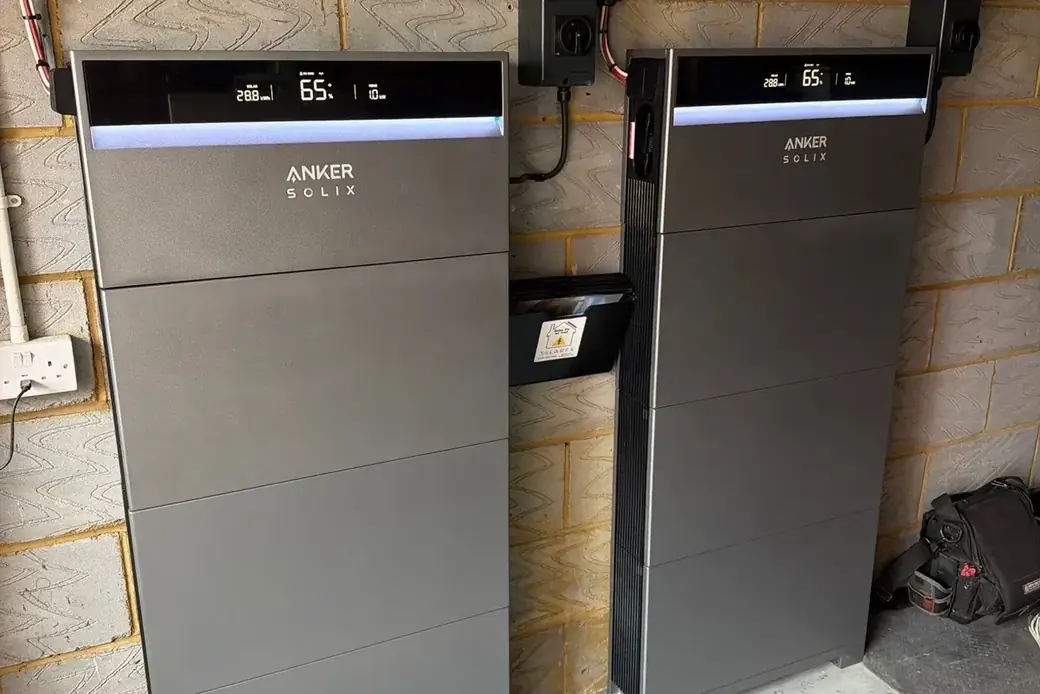
Capacity is usually built from modules, so physical space, floor loading and wall construction scale with the answer. Clearances around the cabinet are set by the manufacturer and are not negotiable.
Two constraints deserve checking before the size is fixed. The inverter has a maximum supported battery capacity, which caps future expansion. And larger systems more often cross the threshold from a G98 notification to a G99 application requiring DNO approval before installation, which adds time to the programme.
Cost
Battery cost does not scale linearly. Installation labour, the inverter and the electrical works are largely fixed, so the second module costs less per kilowatt hour than the first. That argues for not fitting the smallest possible unit, but it does not argue for fitting the largest — the marginal kilowatt hour still has to cycle to be worth anything.
Our approach is to model your consumption against two or three capacities and show what each one saves, so the size is a decision you make on figures rather than one made for you. The usable capacity, power rating and warranty terms of whatever is proposed are stated in the written quotation.
Specification considerations
These are the figures worth comparing when you are reading a quotation. The exact values for the products specified for your installation come from the manufacturer's current datasheet and are stated in your written quotation.
| What to look at | Why it matters |
|---|---|
| Primary input | Half-hourly consumption data from a smart meter, covering at least a full season |
| Secondary inputs | Import and export tariff rates, modelled array generation, and any EV or heat pump load |
| Capacity metric | Sized on usable kWh, not nominal kWh — the two differ on every product |
| Power metric | Continuous discharge kW, sized against typical simultaneous household demand |
| Typical domestic range | Most households land somewhere between 5kWh and 20kWh of usable capacity |
| Expansion | Modular systems allow later capacity increases within the inverter's supported limit |
| Target behaviour | A battery that cycles fully most days; capacity that rarely empties earns nothing |
Where it works, and where it does not
Strengths
- Sizing from real consumption data produces a battery that cycles rather than sitting part-full
- Correct power rating means the battery covers real household loads instead of leaving the grid to top up
- Modular design allows a smaller starting capacity with expansion once a season of data exists
- Right-sizing frees budget for other parts of the system that generate a return
Limitations
- Requires half-hourly data to do properly; without it the sizing is an estimate and should be described as one
- Consumption changes — an EV, a heat pump, a new occupant or a child leaving home all move the answer
- Expansion is bounded by what the inverter supports, so the ceiling should be considered at the outset
- No battery size makes a typical UK house independent of the grid through winter
This page covers one component. For how the whole thing fits together, see solar panels and battery storage.
Common questions
Why not just fit the biggest battery I can afford?
Because capacity that never empties never earns anything. A battery saves money by cycling — filling with cheap or self-generated energy and discharging against expensive import. If it routinely ends the day half full, the unused half is capital doing nothing. Oversized systems are the most common thing we are asked to review, and the honest answer is usually that a smaller battery would have paid back faster.
Can a battery take me off grid?
Not in a UK house at any sensible cost. December generation is a small fraction of June generation, and covering a winter week of demand from storage alone would need capacity far beyond domestic scale, plus an array with nowhere to sit. Storage is for shifting energy by hours, not by seasons.
How does an EV change the sizing?
Substantially, and in both directions. An EV adds a large load, which argues for more capacity. But an EV usually charges overnight on a cheap rate anyway, so it does not need the battery to serve it — and charging both the car and the battery in the same off-peak window may exceed what the supply can deliver at once. It is a load-management question as much as a capacity one.
What if I do not have smart meter data?
We work from annual consumption, occupancy pattern, heating and hot water type, and any known large loads, and we tell you the sizing is an estimate. Where the decision is finely balanced, fitting a modular system at a smaller capacity and adding a module after a season of real data is a better approach than guessing large.
Related services
- Battery storage installationHome battery systems sized against your consumption, sited properly and commissioned with the tariff in mind.
- Solar and battery systemsPanels, hybrid inverter and storage designed as one system, on one scaffold, with one commissioning.
- Battery retrofitAdding storage to a solar system that is already on the roof, without disturbing what works.
- EV charger installationHome charge points installed with a proper load assessment, PEN fault protection and solar-aware scheduling.
The technology behind it
- BatteriesHow home storage works, what determines whether it pays, and the specifications that actually matter.
- LFP batteriesLithium iron phosphate chemistry: why it became the domestic standard, and what it gives up in exchange.
- Hybrid invertersA single unit managing array, battery and house demand, and when fitting one is worth the extra cost.
- Monitoring systemsWhat generation, consumption and battery data actually tells you, and what a system needs fitted to produce it.
Property and roof guides
- Post-1965 homesTrussed rafter roofs, concrete interlocking tile and modern electrics — the most straightforward housing stock to work on.
- 1930s semi-detached homesThe classic suburban semi — hipped or gabled roof, party wall stack, bay window and a side elevation that changes everything.
- New build homesRetrofitting or extending solar on a new build — structural warranty notification, shallow pitches, interrupted roof planes and covenants.
See it on a real installation
- A battery upgrade that became a full system rebuild, East HorsleyThe enquiry was for another 15kWh of storage. The survey found four roof orientations sharing two MPPTs, and the honest answer was to rebuild from the roof upwards.
- Solar, storage and EV charging in Padworth, BerkshireA whole-home energy system on an established tiled roof — solar PV, battery storage, EV charging and a surplus diverter for hot water.
Further reading
- What size battery do I need?How evening consumption, array size, tariff and inverter power rating together decide usable battery capacity.
- Adding a battery to existing solarAC coupling versus replacing the inverter, what a retrofit survey checks, and the network paperwork it can trigger.
- How many solar panels do I need?Why panel count is set by your electricity consumption and the usable area of your roof, not by the size of your house.
Where we work
Information reviewed on 2026-08-23.
Not sure which specification suits your roof?
We design around the property rather than fitting the same system to every house. Tell us the postcode and we will explain what we would specify and why.
Ask us about specification
No obligation. We will review the details, come back to arrange the next step, and issue a written design and fixed quotation before anything is agreed.
Prefer to talk? Call 0118 227 7444.