
Property guide
Solar Panels on Slate Roofs
Natural and fibre cement slate — brittle, holed rather than nibbed, and unforgiving of the wrong fixing method.
Why slate is a different job
Slate is not a small tile. It is thin, dense, brittle stone laid double-lapped and nailed through pre-drilled holes, and it behaves nothing like a nibbed interlocking tile. It cannot be lifted and hung back on a batten the way a tile can, it cannot be relieved to sit over a hook, and it cracks rather than flexes when a fixing bears on it in the wrong place.
Everything about a slate installation follows from that. Slower work, more care, a different fixing method, higher breakage and a higher price.
Fixing methods
Two approaches are used, and the choice depends on slate size, batten gauge and the state of the roof.
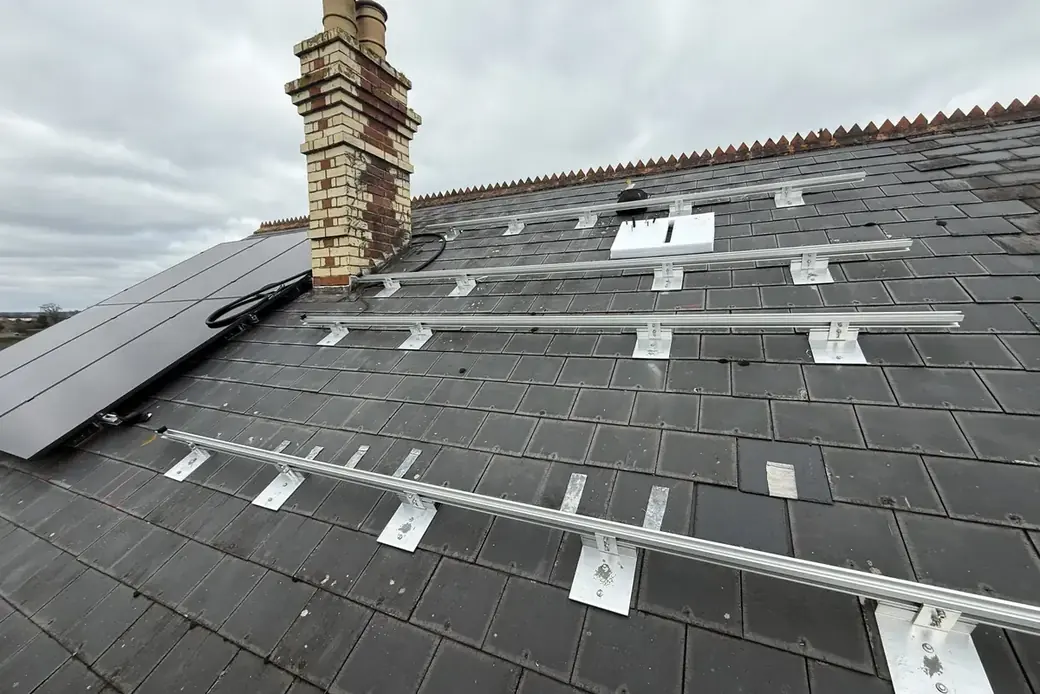
Slate hooks. A purpose-made hook designed to work with the slate courses, taken back to bolt into the rafter, with the mounting bracket carried above the covering. Fewer slates disturbed, but it needs the right hook for the slate dimensions and a batten arrangement that will accommodate it.
Flashing plates. A slate is removed and replaced with a proprietary lead or metal plate that is dressed into the courses and carries the bracket. This gives a positive weathering detail at each fixing point and is often the more robust answer on irregular or reclaimed slate, at the cost of removing a slate at every fixing.
In both cases the bracket bolts into the rafter. Not the batten, not the boarding. Slate roofs on older properties frequently have irregular rafter centres, so the array is set out against measured positions from inside the loft.
Condition assessment
The survey question on a slate roof is not usually whether the array will fit. It is whether the roof has enough life left.
Nail sickness is the recurring finding on Victorian and Edwardian roofs. The slate itself is a durable material and often has decades left, but the iron or steel nails corrode long before it does. Slipped slates, a scatter of mismatched replacements, and slates that lift free with almost no resistance are all signs. A nail sick roof will need stripping and relaying, and an array fixed to it will have to come off and go back.
Fibre cement slate is a separate case. Later products are stable; earlier ones become brittle and can be fragile to walk on. Age and manufacture need establishing before anyone works on the roof.
Slate is also heavy. A slate roof carries a substantial dead load before an array is added, and where a structure is already deflected or has been altered, that needs a proper look.
Design and appearance
Slate roofs are frequently on the properties where appearance matters most — Victorian terraces, older detached houses, conservation areas, listed buildings. All-black panels with black frames read well against slate; silver framing on a dark slate roof does not.
In-roof mounting is worth serious consideration on slate. Sitting the array flush in the plane of the covering is what makes it acceptable on a visible elevation, and it is far easier and cheaper to detail during a re-cover than as a retrofit onto a sound roof.
Access, breakage and limitations
Scaffolding on slate properties is often more involved because they tend to be older, taller and in tighter streets. Slate roofs are also slippery and steep, so roof ladders and proper edge protection are non-negotiable rather than optional.
Breakage is expected. We allow for replacement slates and match as closely as the roof permits, but reclaimed slate varies in size, thickness and colour and a perfect match is not always possible.
The honest limitations: slate costs more, takes longer, breaks more, and on a roof approaching the end of its fixing life it is the wrong sequence of work entirely.
What we check on this type of property
- Slate is brittle, thin and cracks rather than flexes under a badly placed fixing
- Slates are holed and nailed, not nibbed, so they cannot be relieved over a hook
- Nail sickness is common on Victorian and Edwardian roofs
- Slate hooks and flashing plates differ from tile hooks and are slower to fit
- Breakage during installation is expected and must be allowed for
- Reclaimed and Welsh slates vary in size, thickness and colour
- Fibre cement slate behaves differently again and may be brittle with age
- Slate roofs are heavy before an array is added
Common questions
Can solar panels go on a slate roof?
Yes, routinely. It is slower, more skilled and more expensive than tile, and it needs a fixing method designed for slate rather than a tile hook forced into service. The two common approaches are a purpose-made slate hook that sits between the slate courses, or a flashing plate that replaces a slate and carries the mounting bracket. Which one suits depends on the slate size, the batten gauge and the condition of the roof.
Why is slate more expensive?
Labour and risk. Each fixing takes longer, more care is needed to avoid cracking neighbouring slates, and a proportion of what is disturbed will not go back. Matching replacements takes time and reclaimed slate is not cheap. It is a real cost difference rather than a premium applied because the roof looks smart.
What is nail sickness and why does it matter?
The slates outlast their fixings. On a Victorian roof the original nails corrode until slates begin to slip, and you see the effect as slipped or replaced slates dotted across a slope. A nail sick roof is close to needing stripping and relaying, and putting an array on it means paying to remove and refit the panels a few years later. We look for it at survey and say so.
Should I re-slate before fitting solar?
If the roof is within a few years of needing it, yes. Re-covering first means the array is fixed to a sound roof with new battens and a new membrane, and it avoids the cost of removal and refit later. It also allows in-roof mounting to be considered properly, which suits slate very well visually and is far easier to detail during a re-cover than as a retrofit.
Related services
- Solar panel installationSurvey, design, roof works, electrical works and commissioning for a domestic solar PV system.
- In-roof solarPanels integrated into the roof covering rather than mounted above it, with the weathering detailed properly.
- Solar panel removal and refitTaking an array down for roof work, extensions or repairs, and putting it back properly afterwards.
- Solar panel repairsFault diagnosis and repair on arrays that have stopped working, or never quite worked properly.
The technology behind it
- Mounting systemsHooks, rails, clamps and fixings — the part of the installation that decides whether the roof stays watertight.
- All-black panelsPanels with black frames, black backsheets and concealed busbars, and what the appearance costs in output and in price.
- Monocrystalline panelsThe cell technology used in almost every domestic installation, and what half-cut cells actually change on a shaded roof.
Property and roof guides
- Pre-1920 homesSolar on Victorian and Edwardian houses: brittle coverings, irregular rafters, ageing electrics and planning sensitivity.
- Victorian terracesNarrow slate slopes, party walls, rear back-additions and scaffolding through a shared alley — terraced solar on its own terms.
- Listed buildings and conservation areasWhere permitted development rights are reduced or removed, listed building consent is a separate process, and design choices decide the outcome.
See it on a real installation
Further reading
- In-roof vs on-roof solarHow the two mounting approaches differ in appearance, weathering, cost and suitability for different roofs.
- What happens during a solar surveyWhat a surveyor measures, inspects and asks about, and why a quotation without a survey is unreliable.
- Scaffolding and access for solarWhy scaffolding is needed, what affects the cost and duration, and what to expect around your property.
Where we work
Information reviewed on 2026-08-23.
Find out what your property can take
Every design starts with a survey of the actual roof, structure and electrics rather than an assumption about the property type.
Tell us about your property
No obligation. We will review the details, come back to arrange the next step, and issue a written design and fixed quotation before anything is agreed.
Prefer to talk? Call 0118 227 7444.