
Technology
All-Black Solar Panels
Panels with black frames, black backsheets and concealed busbars, and what the appearance costs in output and in price.
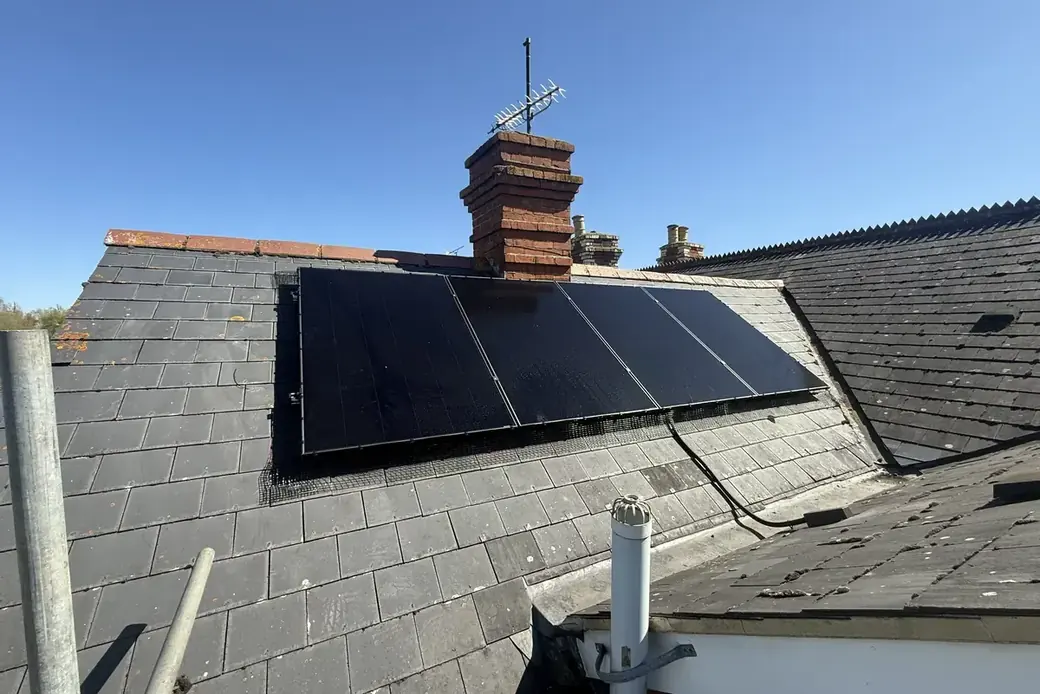
What makes a panel all-black
Three things, and they are worth separating because products described as black do not always change all three.
The frame is anodised black instead of left as mill-finish aluminium. This is the change that does most of the visual work, because a silver frame draws a bright line around every module and turns an array into a grid.
The backsheet — the layer behind the cells — is black instead of white. On a standard module, white backsheet shows through the small gaps between cells as a pale lattice. Black removes it.
The busbars, the fine conductors carrying current across the cell face, are either very thin or moved to the rear of the cell. This removes the silver pinstriping visible close up.
A panel with only a black frame is not the same product as one with all three. Ask which is being quoted.
How it affects performance
A white backsheet does useful work. Light that falls between the cells hits it, reflects, and some of that lands back on cell material and gets converted. Black absorbs it instead, and the absorbed energy becomes heat. So an all-black module loses a small amount of light that would otherwise have been recovered, and runs slightly warmer, which reduces output further because silicon output falls with temperature.
The result is that manufacturers typically list their all-black line at a slightly lower rated output than the equivalent standard module. Over a roof, that means either a little less generation or one extra panel to reach the same capacity.
Where it is used
Street-facing roof slopes. Conservation areas and the settings of listed buildings, where the planning position often turns on how visible and how uniform the array looks. Slate roofs, where a silver-framed array is conspicuous. New-build estates with design codes. And plenty of ordinary houses where the owner simply does not want the roof to look industrial.
Suitability
If the array cannot be seen from anywhere anyone stands, all-black buys nothing and costs something. On a rear roof slope hidden behind a house, standard modules are the rational choice. On a front elevation, or on any roof where appearance will decide whether the project is acceptable to you or to a planning officer, it is usually worth the small penalty.
Installation implications
There are none. Dimensions, weight, fixing points, connectors and mounting compatibility are the same as the standard version of the same product. The one practical note is supply: all-black lines are ordered in smaller volumes, so lead times can be longer, and matching a single replacement module several years later is harder. We plan array layouts so that a future replacement can be kept within one string.
Specification, warranty and cost
Compare the all-black datasheet against the standard datasheet from the same manufacturer rather than against a general claim. Rated output, efficiency, temperature coefficient, product warranty and performance warranty are all stated there, and the all-black figures are frequently a step below the standard ones.
On cost, expect a modest premium per watt, plus the possibility of one additional module to reach the same system size. Your written quotation states the exact panel and price so the difference is visible rather than absorbed.
Specification considerations
These are the figures worth comparing when you are reading a quotation. The exact values for the products specified for your installation come from the manufacturer's current datasheet and are stated in your written quotation.
| What to look at | Why it matters |
|---|---|
| Frame | Black anodised aluminium rather than mill-finish silver |
| Backsheet | Black rather than white, so no light-coloured grid shows between cells |
| Cell interconnection | Fine or rear-mounted busbars to reduce visible silver lines across the cell face |
| Typical output penalty | A black backsheet reflects less light back into the cells and runs warmer, which slightly reduces output |
| Availability | Offered as a distinct product line, usually one step down in rated output from the same maker's standard module |
| Typical use | Street-facing slopes, conservation areas and roofs where the array is visible from ground level |
Where it works, and where it does not
Strengths
- Reads as a single dark rectangle from ground level rather than a grid of cells, which suits slate and dark tile
- Frequently the difference between an acceptable and an unacceptable appearance in a conservation area
- Makes an in-roof array look closer to a rooflight or a slated panel than a bolted-on addition
- No difference in electrical behaviour, mounting or maintenance compared with a standard module
Limitations
- Runs warmer than a white-backsheet panel, so output is slightly lower in hot weather
- Usually a lower rated output than the equivalent standard module, meaning marginally more roof area for the same capacity
- Typically costs more per watt than the standard version of the same panel
- Purely a visual choice; it produces no financial return of its own
This page covers one component. For how the whole thing fits together, see solar panels and battery storage.
Common questions
Do all-black panels produce less electricity?
Slightly. A white backsheet reflects light that misses the cells back up into them, and it also keeps the module a little cooler. A black backsheet does neither. The difference is small — small enough that it is usually outweighed by getting planning acceptance or by the owner being happy with how the roof looks — but it is real and we will not pretend otherwise.
Are they required in a conservation area?
Not automatically. Requirements vary by local authority and by the specific designation, and some conservation areas permit no visible array at all on a principal elevation. Where an array is acceptable in principle, an all-black module on a slate roof is far more likely to be approved than a silver-framed one. We check the position for your address before designing.
Can I mix all-black and standard panels?
Electrically it is possible if they are kept on separate strings or trackers with matched modules on each. Visually it looks like a mistake. If part of a roof is visible and part is not, we would normally either use all-black throughout or split the arrays cleanly so the difference reads as deliberate.
Do black panels get hotter and degrade faster?
They run warmer, which reduces instantaneous output. Manufacturers rate and warrant them on the same terms as their other modules, and the performance warranty on the datasheet applies as written. We would not describe any panel as immune to degradation, black or otherwise.
Related services
- Solar panel installationSurvey, design, roof works, electrical works and commissioning for a domestic solar PV system.
- In-roof solarPanels integrated into the roof covering rather than mounted above it, with the weathering detailed properly.
- Solar and battery systemsPanels, hybrid inverter and storage designed as one system, on one scaffold, with one commissioning.
The technology behind it
- Solar panelsWhat a domestic solar panel is, how it is built, and which specifications on the datasheet actually matter.
- Monocrystalline panelsThe cell technology used in almost every domestic installation, and what half-cut cells actually change on a shaded roof.
- Mounting systemsHooks, rails, clamps and fixings — the part of the installation that decides whether the roof stays watertight.
Property and roof guides
- Listed buildings and conservation areasWhere permitted development rights are reduced or removed, listed building consent is a separate process, and design choices decide the outcome.
- Slate roofsNatural and fibre cement slate — brittle, holed rather than nibbed, and unforgiving of the wrong fixing method.
- Victorian terracesNarrow slate slopes, party walls, rear back-additions and scaffolding through a shared alley — terraced solar on its own terms.
- New build homesRetrofitting or extending solar on a new build — structural warranty notification, shallow pitches, interrupted roof planes and covenants.
Further reading
Where we work
Information reviewed on 2026-08-23.
Not sure which specification suits your roof?
We design around the property rather than fitting the same system to every house. Tell us the postcode and we will explain what we would specify and why.
Ask us about specification
No obligation. We will review the details, come back to arrange the next step, and issue a written design and fixed quotation before anything is agreed.
Prefer to talk? Call 0118 227 7444.