
Technology
Solar Panels
What a domestic solar panel is, how it is built, and which specifications on the datasheet actually matter.
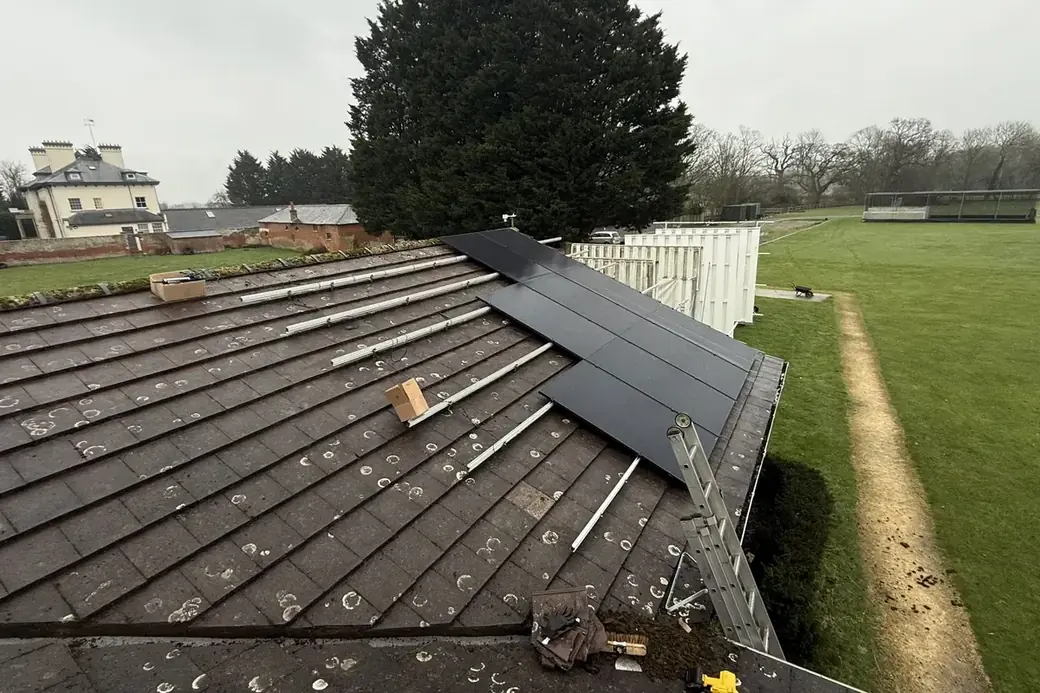
What a solar panel is
A solar panel is a sheet of silicon cells laminated between an encapsulant and a tempered glass front, held in an aluminium frame, with a junction box on the back carrying two DC leads. There is nothing in it that moves. Everything that determines how well it performs was decided in the factory: the cell type, how the cells are cut and interconnected, and the quality of the lamination that keeps moisture out for the next few decades.
How it works
Light striking a silicon cell knocks electrons loose, and the cell’s internal structure pushes them in one direction. That produces a small DC voltage. Cells are wired in series inside the panel to build that up to a usable voltage, and panels are wired in series into a string to build it up further before it reaches the inverter.
Two things follow from this that matter on a real roof. First, a series circuit is limited by its weakest element, which is why shading on one part of an array pulls down more than its share. Bypass diodes in the junction box reduce that effect but do not remove it. Second, silicon loses voltage as it heats, so a panel at 60°C on a still July afternoon produces less than the same panel at 25°C in April. Datasheets state a temperature coefficient for exactly this reason.
Where panels are used
On pitched roofs, on flat roofs using a ballasted or mechanically fixed frame, on ground-mounted frames, and increasingly integrated into the roof plane itself rather than sitting above it. The panel is the same in each case; what changes is the mounting system and the ventilation behind it, which affects operating temperature.
Reading the datasheet
Four figures do most of the work:
- Rated power (Wp). The output at standard test conditions. Useful for comparison, not a prediction of what your roof will make.
- Efficiency. Power per square metre. This is what decides how much you can fit on a constrained roof.
- Temperature coefficient. How much output is lost per degree above 25°C. A smaller number is better on a south-facing roof with little airflow behind the panels.
- Performance warranty. The output the manufacturer commits to at a stated number of years. Compare the retained percentage, not just the warranty length.
Suitability
Almost any sound roof slope from east through south to west will carry panels productively in the UK. North-facing slopes generate, but poorly enough that they rarely justify the cost on their own. The real questions at survey are structural — rafter size and spacing, covering condition — and whether shading will affect the array for a meaningful part of the day.
Installation implications
Panel choice affects the roof work more than people expect. A physically larger panel means fewer fixings and faster installation but less flexibility to fit awkward roof shapes. A heavier panel adds to a load calculation that may already be marginal on an older roof. Frame height affects how the array sits against the covering and how well it ventilates.
Cost
Panels are rarely the largest line in a domestic quotation. Scaffolding, labour, the inverter and the electrical works together usually exceed the cost of the modules. That means choosing a cheaper panel saves less than it appears to, and choosing a better one costs less than it appears to. Your written quotation will state the exact panel, its rated output and its warranty terms, with the manufacturer’s datasheet attached.
Specification considerations
These are the figures worth comparing when you are reading a quotation. The exact values for the products specified for your installation come from the manufacturer's current datasheet and are stated in your written quotation.
| What to look at | Why it matters |
|---|---|
| Typical domestic panel output | 400W to 500W per panel, depending on cell technology and physical size |
| Typical panel dimensions | Around 1.7m to 1.8m tall by 1.1m wide for a standard 60 or 66 half-cell format |
| Typical panel weight | Roughly 20kg to 25kg per panel, before mounting hardware |
| Glass and frame | Tempered front glass in an anodised aluminium frame; some panels are glass-glass with no frame at the long edges |
| Cell format | Half-cut monocrystalline cells are now the domestic norm |
| Warranty structure | A product warranty covering defects and a separate performance warranty covering output over time |
| Degradation | Output falls gradually over the panel life; the exact rate is stated on the product datasheet |
Where it works, and where it does not
Strengths
- Generates electricity from daylight, not direct sun, so a UK panel produces on overcast days as well as clear ones
- No moving parts, so routine maintenance is limited to inspection and occasional cleaning
- Output is predictable enough to model a system before it is installed
- Silent in operation and invisible to neighbours from most angles once installed flush
- Reduces grid import directly, which is worth more per unit than exported electricity
Limitations
- Output is highest in summer and lowest in December and January, which is the opposite of most household demand
- Performance falls as cell temperature rises, so the hottest day of the year is not the best generating day
- Shading on part of an array reduces output disproportionately unless the design accounts for it
- Panels degrade slowly over their life; they do not hold their day-one output indefinitely
- Roof area, not budget, usually sets the ceiling on system size
This page covers one component. For how the whole thing fits together, see solar panels and battery storage.
Common questions
Do solar panels work on cloudy days?
Yes, at reduced output. Panels respond to daylight rather than direct sunlight, so an overcast day in June still generates usefully. What changes is the amount: a bright overcast day might produce a third to a half of what the same roof makes in clear conditions, and a dark winter afternoon produces very little.
How long do solar panels last?
Longer than most other parts of the system. The panels usually outlast the inverter, which is the component most likely to need replacement first. Manufacturers publish both a product warranty and a performance warranty; the specific lengths and the retained-output figures vary between products and are stated on the datasheet supplied with your quotation.
Does panel efficiency matter?
Only as a way of getting more watts onto a limited roof. A more efficient panel produces more power per square metre, which matters when the roof is the constraint. If the roof is larger than the system you need, a slightly lower efficiency panel at a lower cost per watt can be the better buy.
Will panels damage my roof?
Not if the fixings go into the rafters and the covering is properly weathered afterwards. Damage we see on other installers' work is almost always a fixing set into a batten rather than a rafter, or a tile that has been cut back and never made watertight.
Related services
- Solar panel installationSurvey, design, roof works, electrical works and commissioning for a domestic solar PV system.
- Solar and battery systemsPanels, hybrid inverter and storage designed as one system, on one scaffold, with one commissioning.
- In-roof solarPanels integrated into the roof covering rather than mounted above it, with the weathering detailed properly.
- Solar panel maintenanceScheduled servicing of the whole system — array, fixings, DC side, inverter and monitoring — not just the glass.
The technology behind it
- Monocrystalline panelsThe cell technology used in almost every domestic installation, and what half-cut cells actually change on a shaded roof.
- All-black panelsPanels with black frames, black backsheets and concealed busbars, and what the appearance costs in output and in price.
- N-type and TOPCon panelsThe cell architecture replacing PERC in domestic modules, and what n-type silicon genuinely changes.
- Mounting systemsHooks, rails, clamps and fixings — the part of the installation that decides whether the roof stays watertight.
- InvertersWhat the inverter does, how MPPT works, and how the four architectures compare honestly against each other.
Property and roof guides
- Tile roofsConcrete interlocking, clay pantile and plain tile — the most common covering we work on, and the most forgiving.
- Slate roofsNatural and fibre cement slate — brittle, holed rather than nibbed, and unforgiving of the wrong fixing method.
- East-west roofsLess annual total than south, a flatter daily curve, higher self-consumption — and a design that pairs naturally with storage.
See it on a real installation
- Solar, storage and EV charging in Padworth, BerkshireA whole-home energy system on an established tiled roof — solar PV, battery storage, EV charging and a surplus diverter for hot water.
- Flat-roof solar PV in Benson, OxfordshireA specialist flat-roof mounting system turning an unused section of flat roof into a working array, with a tidy internal electrical installation.
Further reading
- How many solar panels do I need?Why panel count is set by your electricity consumption and the usable area of your roof, not by the size of your house.
- Solar panel degradation and lifespanHow panel output declines gradually over time, which components have shorter lives, and what determines how long a system lasts.
- Solar panel warranties explainedThe difference between product, performance, inverter and workmanship cover — and what each one actually obliges someone to do.
Where we work
Information reviewed on 2026-08-23.
Not sure which specification suits your roof?
We design around the property rather than fitting the same system to every house. Tell us the postcode and we will explain what we would specify and why.
Ask us about specification
No obligation. We will review the details, come back to arrange the next step, and issue a written design and fixed quotation before anything is agreed.
Prefer to talk? Call 0118 227 7444.