
Property guide
Solar Panels on Tile Roofs
Concrete interlocking, clay pantile and plain tile — the most common covering we work on, and the most forgiving.
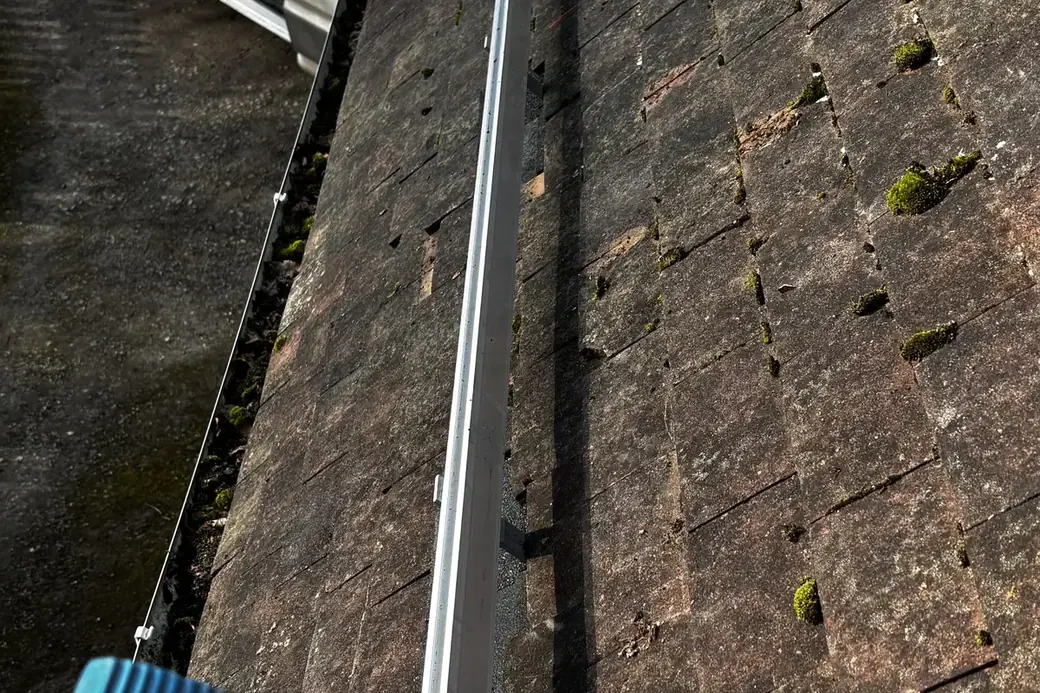
The most common covering
Tile covers the majority of the housing we work on. Concrete interlocking tile from the 1950s onwards, clay pantile and double Roman across older and regional stock, and plain clay tile on the oldest properties and on anything built to look older.
They are not equivalent. The fixing detail, the labour, the breakage rate and the price all change with the tile.
How the fixing works
The principle is the same across every tile type and it is worth stating plainly, because getting it wrong is the most common defect we find on other people’s installations.
A tile hook is a shaped steel bracket. Its foot bolts into the rafter. Its neck passes out under the tile above and turns up to receive the mounting rail. The tile that sits over the hook has a small amount of material relieved from its underside so that it beds down flat rather than rocking on the steel.
Nothing is drilled through the face of a tile. Nothing is fixed to a batten — a batten is a thin timber for hanging tiles on and has no structural capacity for array loading. The load path runs hook to rafter; the water path runs over the top of the tile as it always did. Separating those two paths is what keeps a tiled roof watertight after an installation.
Tile by tile
Concrete interlocking. The easiest. Large format, robust, regular, with a well-established hook detail and spares available. Old ones become brittle and the surface delaminates, so a 1970s roof yields more breakages than a 1990s one.
Clay pantile and double Roman. The profile is the complication. A hook has to match the tile shape so the relieved tile sits properly over it, and reclaimed pantile varies in size and camber, which makes setting out slower.
Plain clay tile. Small, double-lapped and hand-nailed. Disturbing one disturbs several, breakage is higher, and the labour per fixing is substantially greater. Priced accordingly.
Dry-fix systems. Modern ridges, hips and verges use proprietary dry-fix components rather than mortar. Where the array perimeter approaches them, they are reinstated with their own parts, not bedded in.
Structure and set-out
Fixings land in rafters or truss members, so the array is set out against the actual centres. On trussed roofs those are regular and predictable. On cut roofs and older properties they wander, and rail-based mounting is what absorbs the variation — after the centres have been measured from inside the loft rather than assumed.
Beneath the tiles, membrane type matters. Modern breathable membrane is tolerant but is part of the ventilation strategy. Older bitumen felt tears at a fixing and needs dressing. Pre-war roofs frequently have no membrane at all, which raises the standard for how precisely tiles go back.
Design, access and limitations
Tile roofs allow conventional on-roof mounting with an air gap behind the panels, which keeps them slightly cooler and marginally more productive than an integrated array. In-roof is the alternative where appearance matters: the tile under the array is removed and replaced with a tray system so the panels sit flush.
Bird proofing is worth considering on tile. The gap between panel and tile is an attractive nesting space for pigeons and gulls, and mesh fitted at installation is much cheaper than clearing a colony later.
Honest limitations: an old, brittle covering nearing the end of its life should be replaced before an array goes on it, obsolete tile profiles can be difficult to match, and no tile roof is immune to a poor fixing detail. The method is what makes the difference, not the material.
What we check on this type of property
- Tile hooks pass under the tile above and bolt into the rafter, never the batten
- The tile beneath the hook is relieved so it sits back down flat
- Concrete interlocking tile is the easiest covering; plain clay tile is the most laborious
- Pantile and double Roman profiles need a hook matched to the tile shape
- Ageing concrete tiles delaminate and break when handled
- Membrane condition beneath the tiles affects reinstatement
- Dry-fix ridge and verge systems must be reinstated with their own components
- Some breakage is inevitable and replacements need to match
Common questions
Do the fixings go through the tiles?
No. A tile hook passes under the tile above, bolts into the rafter, and the tile it sits over is relieved — a small amount of material removed — so it lies flat rather than rocking. Nothing is drilled through the face of a tile on a standard installation. A fixing that penetrates the tile face is a leak waiting to happen and is not how the mounting manufacturers specify their systems.
How many tiles will break?
On sound modern concrete interlocking tile, very few. On plain clay tile, more, because each one is small and hand-laid and lifting one disturbs several. On concrete tile that is forty or fifty years old and delaminating, more again. We allow for replacements in the quotation and source a match where we can; where the tile is obsolete we discuss the options before starting.
Can panels go back on if the roof is re-covered later?
Yes. An on-roof array comes off in sections and goes back on the same mounting once the roof is done. It needs scaffolding and proper electrical isolation and re-commissioning, so it is a planned job. If your roof is within a few years of needing re-covering, the sensible sequence is to re-cover first and fit the array afterwards.
What if my roof has no membrane?
It changes the method rather than the feasibility. Without a membrane there is nothing behind the tile to catch wind-driven rain, so tiles must go back precisely and anything damaged replaced rather than patched. It is common on pre-war roofs. Where felt is present but perished into strips, we dress the penetration points properly rather than leaving torn material around a fixing.
Related services
- Solar panel installationSurvey, design, roof works, electrical works and commissioning for a domestic solar PV system.
- In-roof solarPanels integrated into the roof covering rather than mounted above it, with the weathering detailed properly.
- Bird proofingMesh and clip systems to keep pigeons out from under an array, fitted to the panels rather than the roof.
- Solar panel removal and refitTaking an array down for roof work, extensions or repairs, and putting it back properly afterwards.
The technology behind it
- Mounting systemsHooks, rails, clamps and fixings — the part of the installation that decides whether the roof stays watertight.
- Solar panelsWhat a domestic solar panel is, how it is built, and which specifications on the datasheet actually matter.
- All-black panelsPanels with black frames, black backsheets and concealed busbars, and what the appearance costs in output and in price.
- Bird protectionMesh and clip systems that close the gap under an array, why pigeons nest there, and how it is done without damaging the roof.
Property and roof guides
- Post-1965 homesTrussed rafter roofs, concrete interlocking tile and modern electrics — the most straightforward housing stock to work on.
- 1930s semi-detached homesThe classic suburban semi — hipped or gabled roof, party wall stack, bay window and a side elevation that changes everything.
- Slate roofsNatural and fibre cement slate — brittle, holed rather than nibbed, and unforgiving of the wrong fixing method.
See it on a real installation
Further reading
- In-roof vs on-roof solarHow the two mounting approaches differ in appearance, weathering, cost and suitability for different roofs.
- What happens during a solar surveyWhat a surveyor measures, inspects and asks about, and why a quotation without a survey is unreliable.
- Scaffolding and access for solarWhy scaffolding is needed, what affects the cost and duration, and what to expect around your property.
Where we work
Information reviewed on 2026-08-23.
Find out what your property can take
Every design starts with a survey of the actual roof, structure and electrics rather than an assumption about the property type.
Tell us about your property
No obligation. We will review the details, come back to arrange the next step, and issue a written design and fixed quotation before anything is agreed.
Prefer to talk? Call 0118 227 7444.